Yes, you can install solar panels on an ADU in California. What surprises most homeowners is that in many cases you have to.
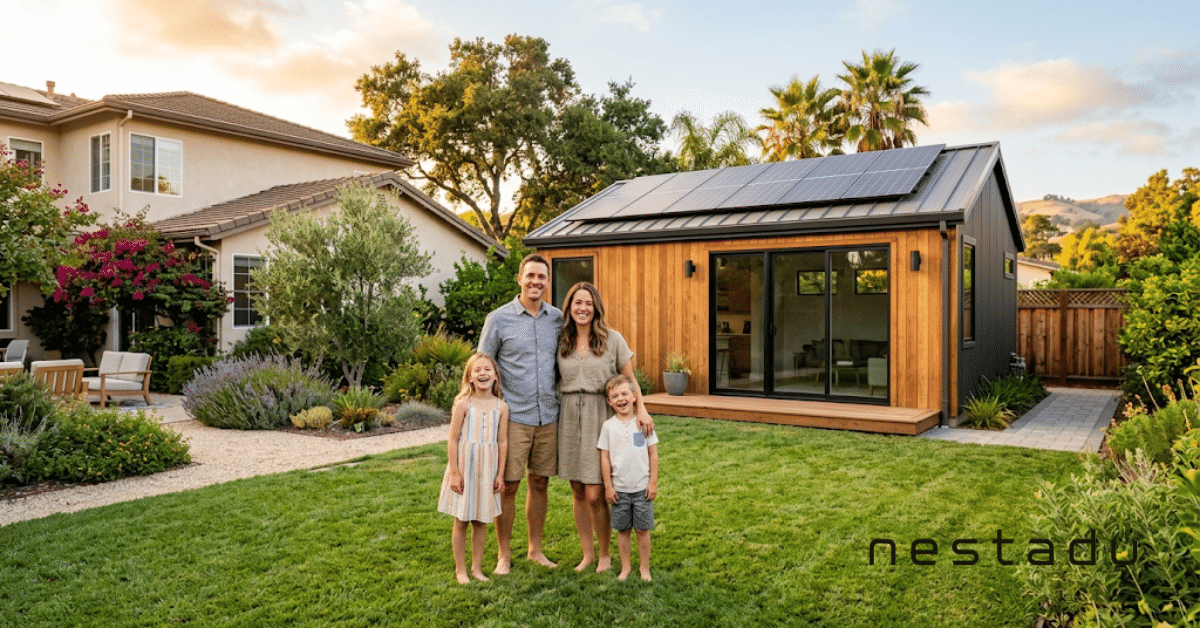
Under California’s Energy Code, a newly built detached ADU counts as new residential construction, which triggers the solar photovoltaic requirement. At Nestadu, solar is one of the first things we settle during design because it affects roof shape and electrical service.
When Solar Is Required and When It Is Optional
The answer depends entirely on which type of ADU you are building. Detached units are the ones caught by the requirement, while anything built inside or attached to your existing home is treated as an addition.
| ADU Type | Solar Required? |
| New detached ADU | Generally yes |
| Attached ADU or addition | Usually exempt |
| Garage or basement conversion | Exempt |
| Interior space conversion | Exempt |
Even when the requirement applies it is not absolute, and several exemptions exist:
- Shading exemption. Heavy shade from trees, the main house, or neighboring structures can reduce or remove the obligation.
- Limited roof area. If the roof cannot physically fit the calculated system, the requirement scales down.
- Community solar. Some utilities allow participation in a shared offsite array instead of rooftop panels.
- Compliance trade-offs. Better insulation or higher-efficiency equipment can offset part of the requirement in the Title 24 calculation.
Can the ADU Share Your Existing Home Solar System?
This is the question we field most often, and the answer hinges on metering. If the ADU sits on the same electric meter as your main house, the existing array can serve both loads, provided it has capacity to spare.
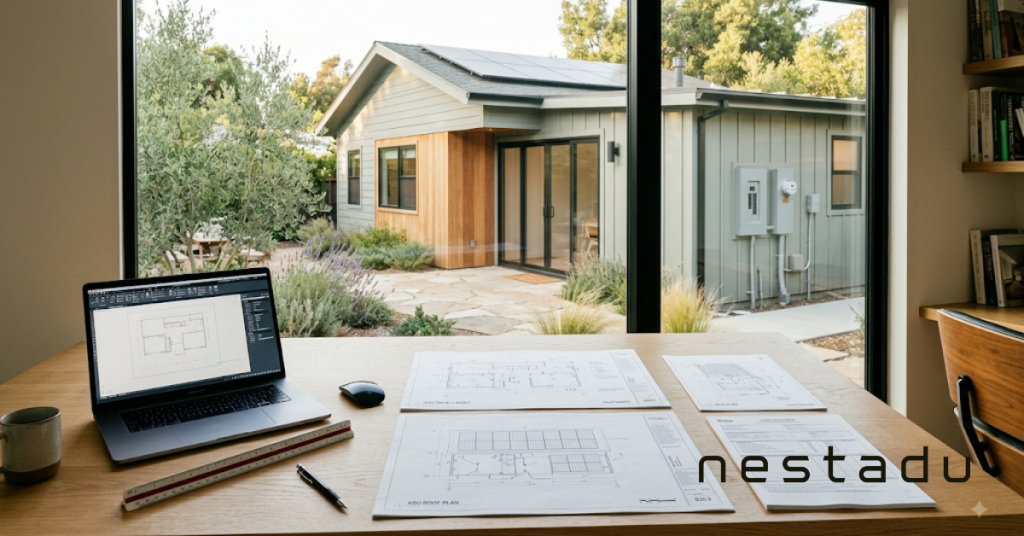
Most home arrays were sized to the original house load, so adding a second dwelling often means expanding the array or replacing the inverter. Separate metering means a separate utility account, its own interconnection agreement, and in practice a separate system.
- Same meter: simpler and cheaper, but the existing array may need expanding
- Separate meter: cleaner for rental billing, but needs its own interconnection
- Inverter headroom: older string inverters often cannot accept extra panels
- Utility approval: any change to an existing interconnection requires a new application
The Electrical Side Most Articles Skip
Solar is the visible part. The electrical infrastructure underneath it causes far more delays and cost overruns than the panels themselves.
Older California homes frequently run on 100-amp service, and adding a second dwelling with its own kitchen, HVAC, and water heater often pushes that past capacity. The pieces that need to line up:
- Main panel capacity. A 100 to 200 amp upgrade typically runs $2,500 to $5,000 including utility coordination.
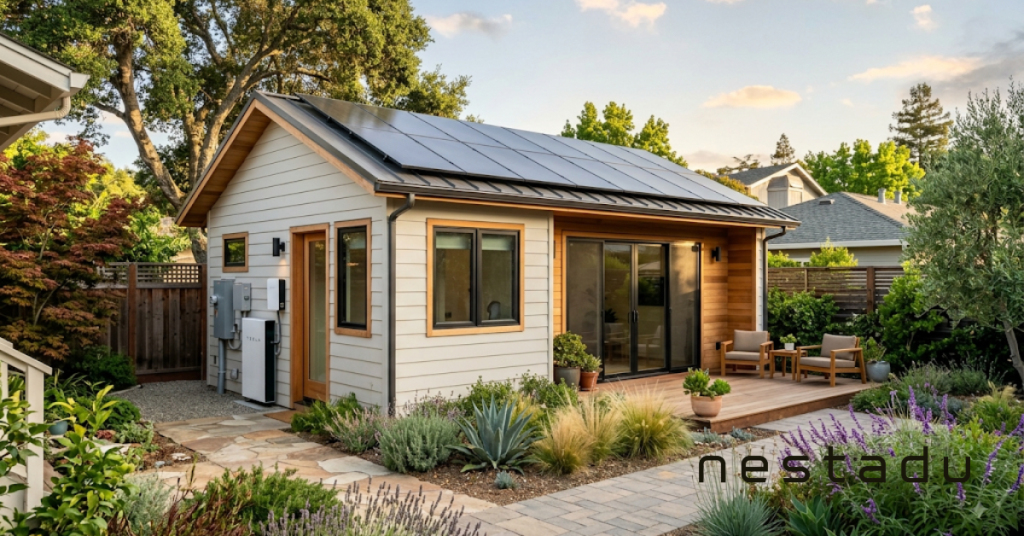
- Subpanel for the ADU. Feeds the unit and gives it dedicated breakers regardless of metering setup.
- Load calculation. Determines both service size and the PV system size the Energy Code requires.
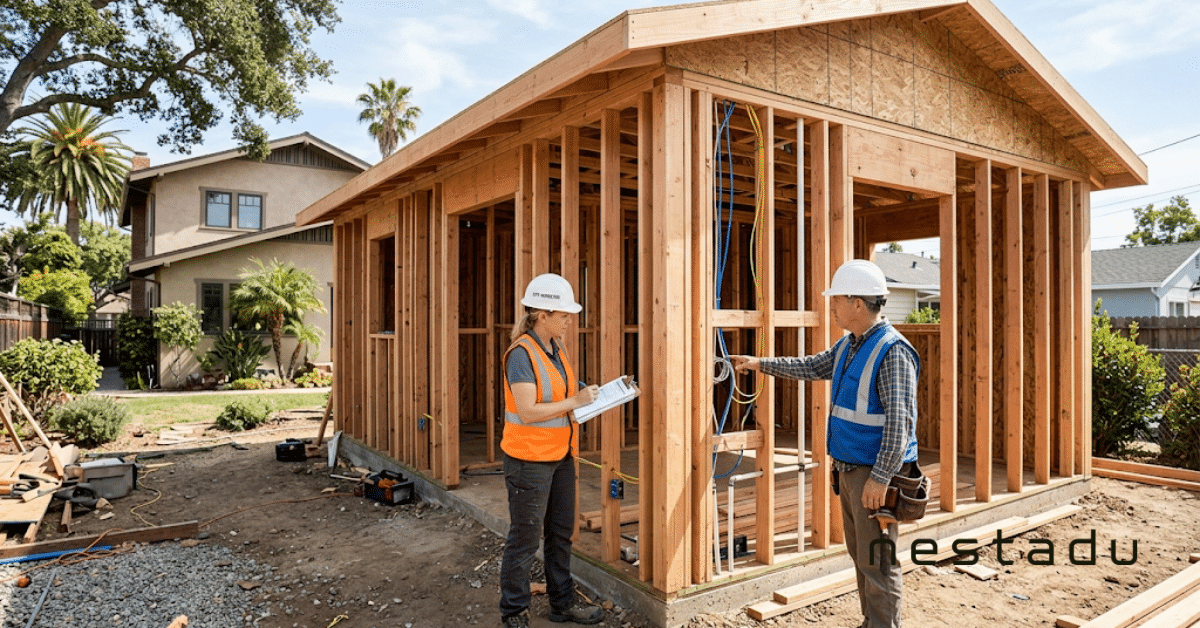
- Roof structure. Framing must carry the array, which is simple in new construction and awkward to retrofit.
- Interconnection agreement. PG&E, SCE, and SDG&E each run their own timeline, often several weeks.
What Solar on an ADU Costs
A typical detached ADU needs a 2 kW to 5 kW system depending on square footage, climate zone, and how the unit will be used. That works out to roughly six to fourteen panels.
Installed pricing in California generally lands between $2.50 and $4.00 per watt before incentives. Bundling solar into the original build is consistently cheaper than adding it later, since the roof is already open and one permit covers everything.
- Solar array (2 to 5 kW): $6,000 to $16,000
- Battery storage (10 to 13 kWh): $10,000 to $18,000
- Electrical service upgrade: $2,500 to $5,000 if needed
- Interconnection and permitting fees: $500 to $2,000
Incentive programs at the federal and state level have shifted considerably in recent years, so confirm current availability before building any credit into your budget.
Does Solar on an ADU Actually Pay for Itself?
The economics changed in April 2023 when California moved to a net billing tariff. Exported power now earns far less than it did under the old net metering rules, which reshapes the entire calculation.
Value has shifted from selling power back to the grid toward using it the moment it is produced. An ADU rented to a tenant who works from home consumes power during peak production hours, while a unit sitting empty until evening exports most of what it generates at a low rate.
- High daytime self-consumption, no battery: roughly 8 to 12 years payback
- Low daytime use, no battery: 12 to 18 years or longer
- With battery storage: shorter effective payback plus outage protection, at higher upfront cost
Do You Need a Battery?
Under the current tariff structure, batteries matter more than they used to. Storing midday production for evening use captures full retail value instead of the reduced export rate.
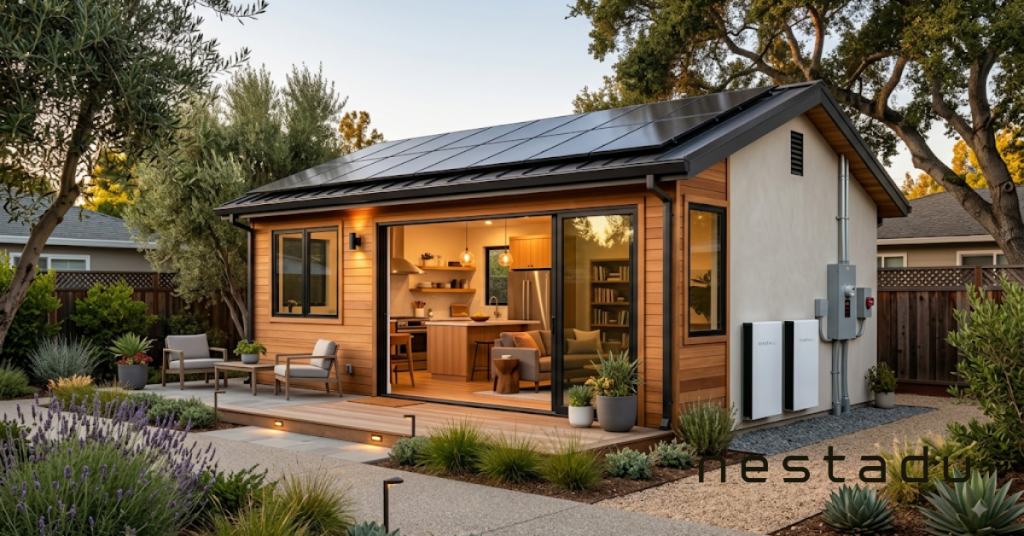
Batteries also cover outages, which matters in wildfire-prone regions where public safety power shutoffs are routine. Skip the battery if the unit will be occupied during daylight hours, your budget is tight, or your area has stable power.
Mistakes That Cost Homeowners Money
Most solar problems on ADU projects trace back to sequencing. The decisions get made in the wrong order, and fixing them later is expensive.
- Finalizing roof design before the solar calculation. Orientation and pitch determine how well the array performs.
- Ignoring shade from the main house. A two-story home can shade a detached ADU roof through most of winter.
- Undersizing electrical service. Discovering a needed panel upgrade mid-build stalls everything.
- Assuming the existing array covers the new unit. It rarely does without expansion.
- Retrofitting after completion. Costs more, needs a separate permit, and may require roof work.
- Skipping the Title 24 review early. You learn your requirement too late to design around it.
How Nestadu Handles Solar on ADU Projects
We treat solar as a design input rather than a line item added at the end. Roof orientation, pitch, and available area are planned around the array from the first set of drawings.
During feasibility Nestadu assesses your electrical service, existing solar system, meter configuration, and shading conditions. The Title 24 compliance report then goes in with your permit package fully documented, so plan check does not send it back.
Planning Solar Into Your ADU From the Start
Solar on an ADU is not a question of whether it is allowed. It is a question of whether your build type requires it, whether your roof and electrical can support it, and whether the numbers work for how the unit will be used.
Contact Nestadu for a free feasibility review. We will confirm whether solar is required for your ADU type, check your electrical capacity, and give you a realistic cost picture before you commit.
Frequently Asked Questions
Is solar mandatory on all ADUs in California?
No. Newly built detached ADUs generally must include solar under the Energy Code. Attached ADUs, garage conversions, and interior conversions are typically exempt because they count as additions rather than new construction.
Can I get an exemption from the ADU solar requirement?
Sometimes. Heavy shading, insufficient usable roof area, or participation in a community solar program can reduce or remove the requirement. Your Title 24 consultant documents the exemption in the compliance report.
Will my ADU need its own electric meter?
Not necessarily. Many ADUs share the main house meter, which is simpler and cheaper. A separate meter makes sense if you are renting the unit and want the tenant billed directly.
How many solar panels does an ADU need?
Most detached ADUs need roughly six to fourteen panels, or 2 kW to 5 kW. The exact figure comes from a load calculation based on square footage, climate zone, and equipment efficiency.
Can I add solar to my ADU after it is built?
Yes, but it costs more. Retrofitting requires its own permit, separate electrical work, and sometimes roof modifications that would have been simple during original construction.