
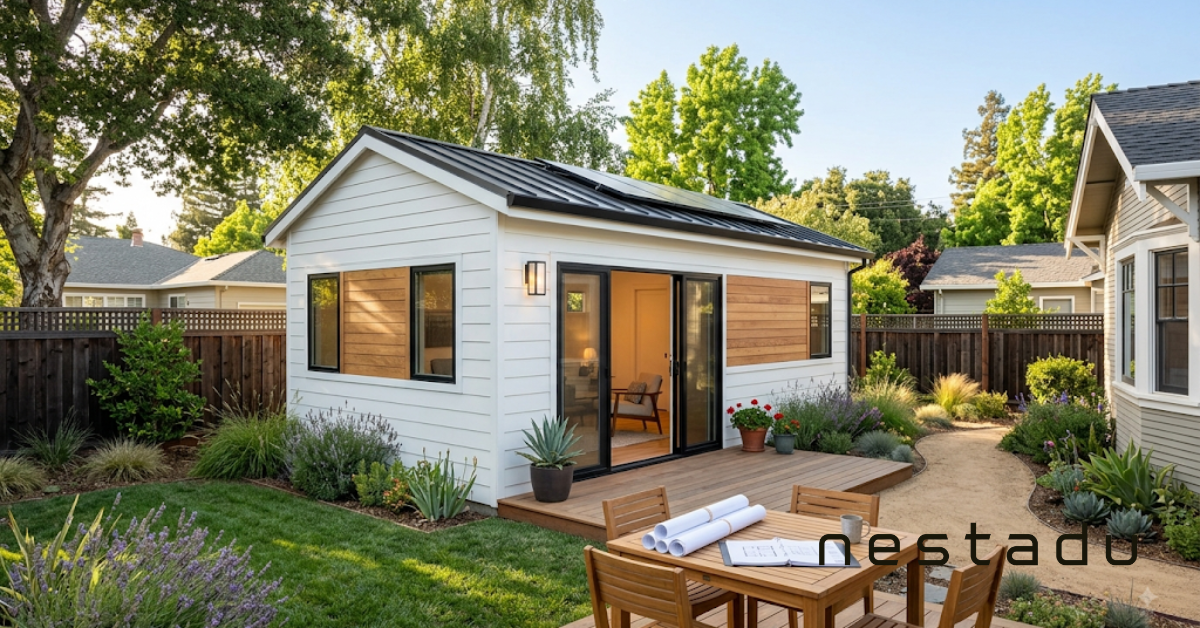
The four features that make the biggest difference in an ADU are a tightly sealed building envelope, a heat pump for heating and cooling, a heat pump water heater, and solar paired with battery storage. Everything else is a smaller adjustment on top of those.
California’s Title 24 energy code already requires several of these, so the real question is what to add beyond code and what to skip. At Nestadu, that conversation happens during design, because retrofitting efficiency into a finished ADU costs far more than building it in.
Why Efficiency Matters More in an ADU Than a Main House
An ADU is small, so every weak point in the envelope represents a much larger share of total heat loss. One poorly insulated wall in a 600 square foot unit affects comfort in a way the same wall never would in a 2,400 square foot house.
The Best Energy-Efficient Features for ADUs
There is a financial side too. If you are renting the unit out, the monthly utility bill affects what tenants will pay and how quickly the ADU pays for itself.
Start With the Building Envelope
No amount of expensive equipment compensates for a leaky shell. A high-efficiency heat pump in a poorly sealed ADU runs constantly and still leaves rooms uncomfortable, which is why envelope work should always come before equipment decisions.
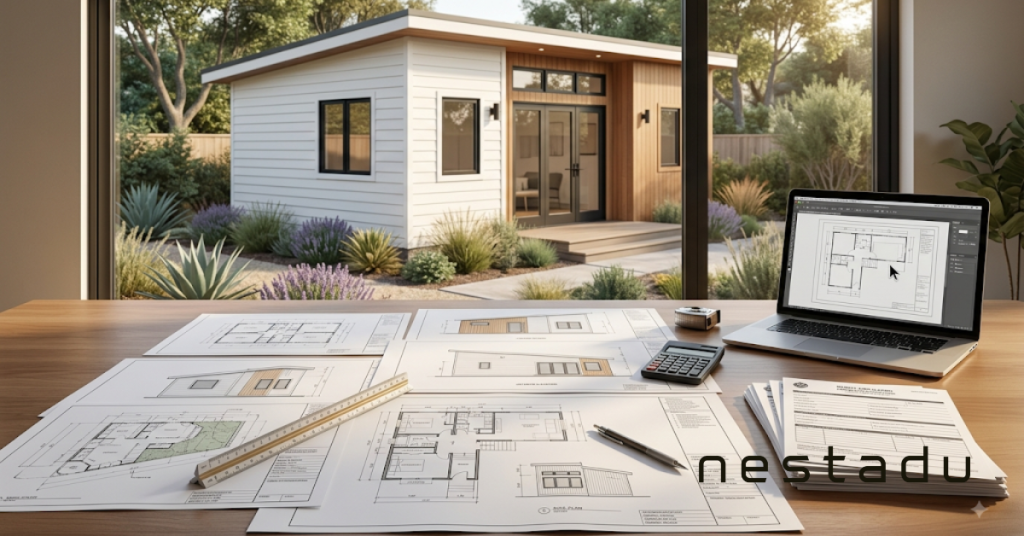
California requires HERS verification of insulation quality and duct sealing on new construction, so this work gets inspected regardless. Building above the minimum is where the actual savings live, and it is usually the cheapest upgrade on the whole project.
- Continuous exterior insulation to interrupt thermal bridging through studs
- Air sealing at top plates, rim joists, and every penetration
- Dual or triple pane windows with low-E coating and a low U-factor
- Cool roof or radiant barrier, particularly in Central Valley and inland Southern California climate zones
Heat Pumps for Heating and Cooling
Ductless mini-split heat pumps have become the default for ADUs. There is no ductwork losing conditioned air, no attic space needed for equipment, and one outdoor unit can serve one or two indoor heads comfortably.
The 2022 Title 24 update set heat pumps as the baseline for space conditioning across most California climate zones. Gas furnaces now carry a compliance penalty that must be offset elsewhere in the design, which typically costs more than the furnace saves.
Sizing is where most ADU projects go wrong. Contractors used to full houses routinely install units too large for a small footprint, and an oversized heat pump short cycles, wastes electricity, and never dehumidifies properly. Nestadu runs a load calculation on every unit instead of working from square footage rules of thumb.
Heat Pump Water Heaters
A heat pump water heater uses roughly a third of the electricity of a standard electric resistance model. In a unit serving one or two people, that difference shows up on the very first bill.
There is a practical catch worth planning for. These units pull heat from the surrounding air and need adequate space and airflow, usually 700 to 1,000 cubic feet, so a tight interior closet will not work. They also produce cool air as a byproduct, which is welcome in summer and a nuisance in winter if placement is careless.
Solar Panels and Battery Storage
This is where most articles get the detail wrong. California’s Title 24 solar mandate generally applies to newly constructed detached ADUs, while attached ADUs, garage conversions, and interior conversions are usually exempt because they count as additions rather than new dwellings. Additional exemptions exist for heavily shaded roofs and very small units.
The economics shifted in 2023 when California moved to the Net Billing Tariff, commonly called NEM 3.0. Exported power now earns far less than the retail rate, meaning the value comes from consuming your own production rather than selling it back. That single change is what moved battery storage from luxury add-on to a serious consideration.
- Typical ADU system size: 2 to 4 kW depending on all-electric loads
- Solar-ready conduit run during construction even if panels come later
- Battery storage for evening use and outage backup
- Metering choice, since sharing a meter with the main house changes how production offsets consumption
Going All-Electric
Skipping the gas line entirely gets easier to justify once homeowners see the numbers. There is no trenching cost, no gas meter fee, no combustion safety testing, and no venting to design around.
Cities including Berkeley, San Jose, and Sacramento have adopted reach codes pushing new construction toward all-electric anyway. Induction cooktops and heat pump dryers cover the two appliances people ask about most, and both perform as well as their gas equivalents.
Ventilation and Smart Controls
A tight envelope creates a problem a leaky one never had. Once an ADU is sealed properly, mechanical ventilation stops being optional and becomes a code requirement under ASHRAE 62.2.
An energy recovery ventilator brings in fresh air while transferring heat from the outgoing air, so you get air quality without discarding energy you already paid to condition. Paired with a smart thermostat, it gives you scheduling control that matters even more in a rental where occupancy patterns are unpredictable.
Lighting, Appliances, and Water Fixtures
These are the smaller line items, but they still count toward Title 24 compliance and cost almost nothing to specify correctly during design rather than after.
- All high-efficacy LED lighting, a hard Title 24 requirement
- ENERGY STAR rated appliances throughout
- WaterSense fixtures and low-flow toilets
- Compact plumbing runs with insulated hot water lines to cut wait time and standby loss
Which Features Pay Back Fastest
Not every upgrade earns its cost back at the same rate, and knowing the order helps when the budget tightens. Envelope work almost always wins because it is inexpensive per unit of savings and it lasts the life of the building.
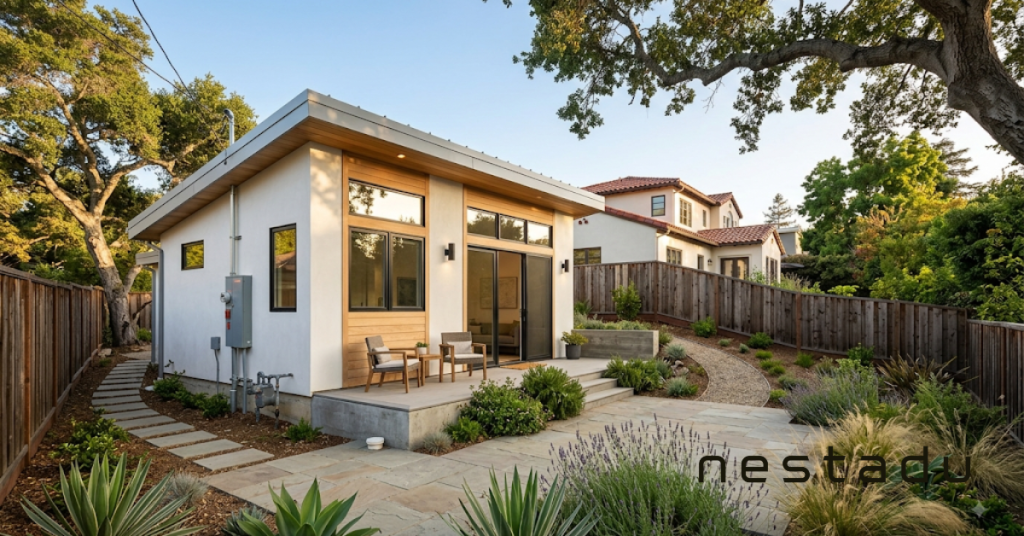
Solar and battery sit at the opposite end. They deliver the largest absolute savings but carry the highest upfront cost, which is exactly why they make the most sense only after the rest of the design is already efficient.
- Air sealing and insulation, the best return per dollar spent
- Heat pump water heater, typically 3 to 5 years
- Ductless mini-split heat pump, 5 to 8 years against resistance heating
- LED lighting and ENERGY STAR appliances, immediate and inexpensive
- Solar array, 7 to 12 years under current billing rules
- Battery storage, the longest payback but adds outage protection
What Title 24 Requires vs What Is Optional
Knowing the split prevents you from paying extra for something already included in the build, or assuming something is covered when it never was. Most homeowners are surprised by how much the code already handles.
The required list covers heat pump baselines for space and water heating in most climate zones, HERS verification of insulation and duct work, one hundred percent high-efficacy lighting, solar on newly constructed detached ADUs, and minimum insulation and window performance values.
Optional but usually worth the money: battery storage, energy recovery ventilation, triple pane windows in colder zones, insulation above minimum, and induction cooking with heat pump laundry.
Rebates and Incentives Worth Checking
California runs several programs that offset the cost of electric equipment, including TECH Clean California for heat pumps and the Self-Generation Incentive Program for battery storage. Individual utilities such as PG&E, SCE, and SMUD run their own rebates on top of those.
Federal energy credits have changed significantly in the past year and state program funding opens and closes on short notice. Confirm what is active before you build any incentive into your budget rather than after the fact.
Frequently Asked Questions
Do all ADUs in California need solar panels?
No. The requirement generally applies to newly built detached ADUs. Conversions and attached units are usually exempt, and shading or size exemptions can also apply.
Is a mini-split enough to heat and cool an ADU?
Yes, in nearly every case. A correctly sized single-zone or two-zone system handles a typical ADU footprint without trouble.
How much can an efficient ADU save each month?
Compared to a code-minimum build using resistance heating, homeowners commonly see 40 to 60 percent lower energy costs, which is meaningful on a rental.
Does my ADU need a separate electrical meter?
Not always. Shared metering is allowed in many jurisdictions and is simpler, though a separate meter makes sense if you plan to bill a tenant directly.
What is a HERS test?
An independent verification of insulation installation quality, duct sealing, and equipment performance. It is required for Title 24 compliance on new ADU construction.
Build an ADU That Costs Less to Run
Efficiency decisions are cheapest at the drawing stage and most expensive after drywall goes up. Getting the envelope, equipment, and solar strategy right together produces better results than adding upgrades one at a time.
Nestadu builds accessory dwelling units across California and designs each one around its specific climate zone rather than a generic spec sheet. Reach out for a consultation and we will walk through which features actually pay off on your property.