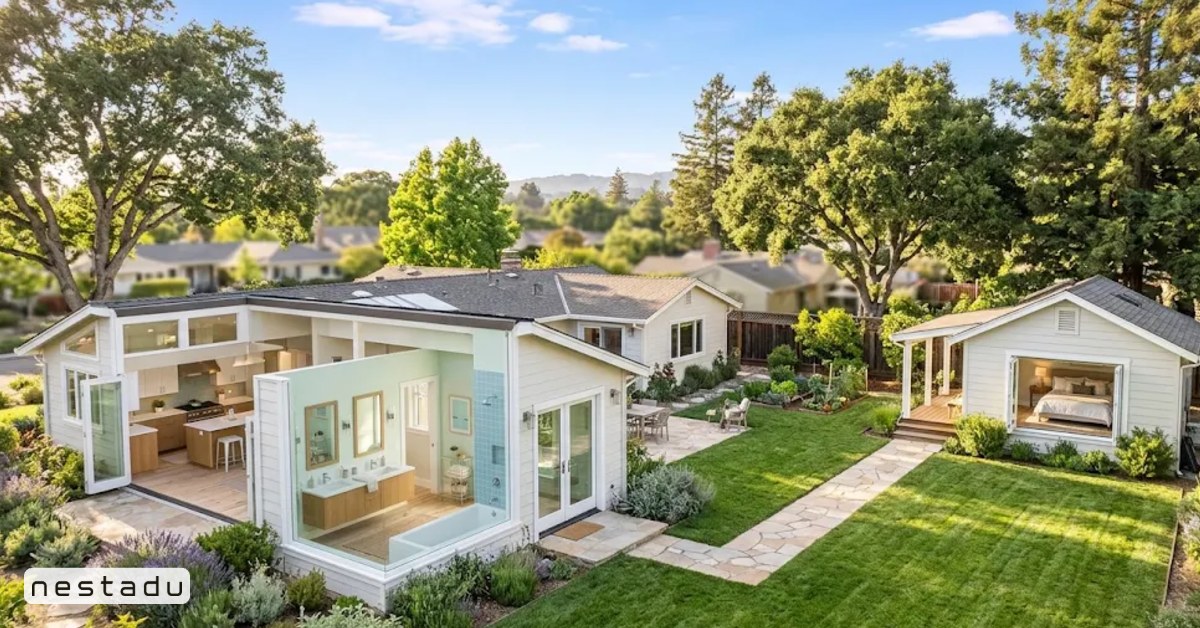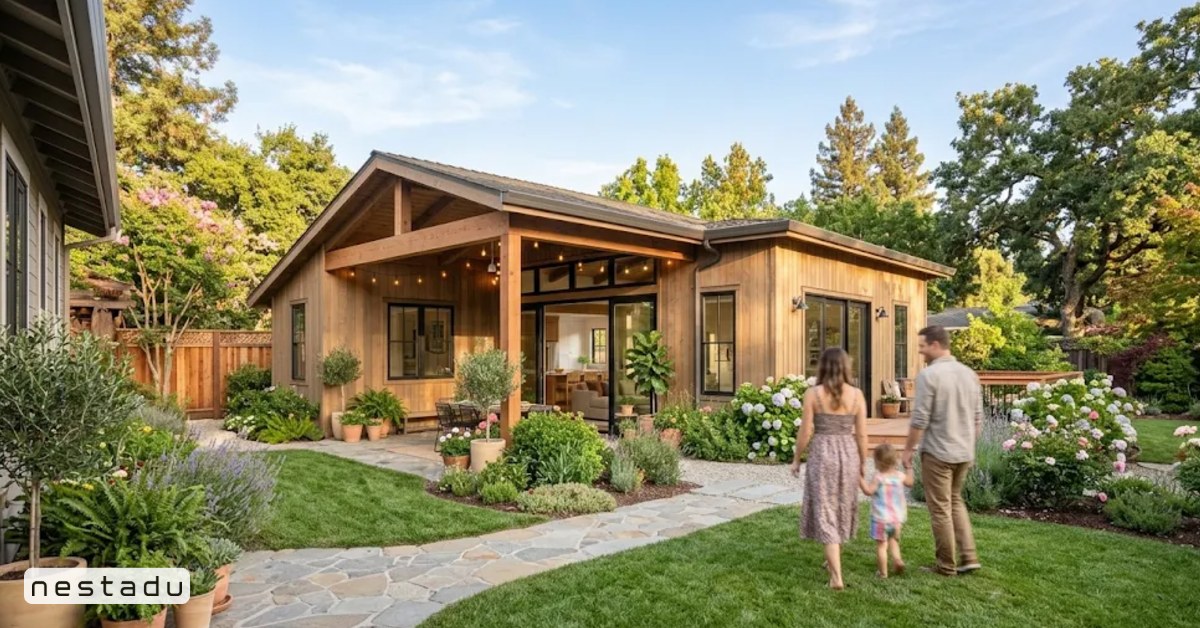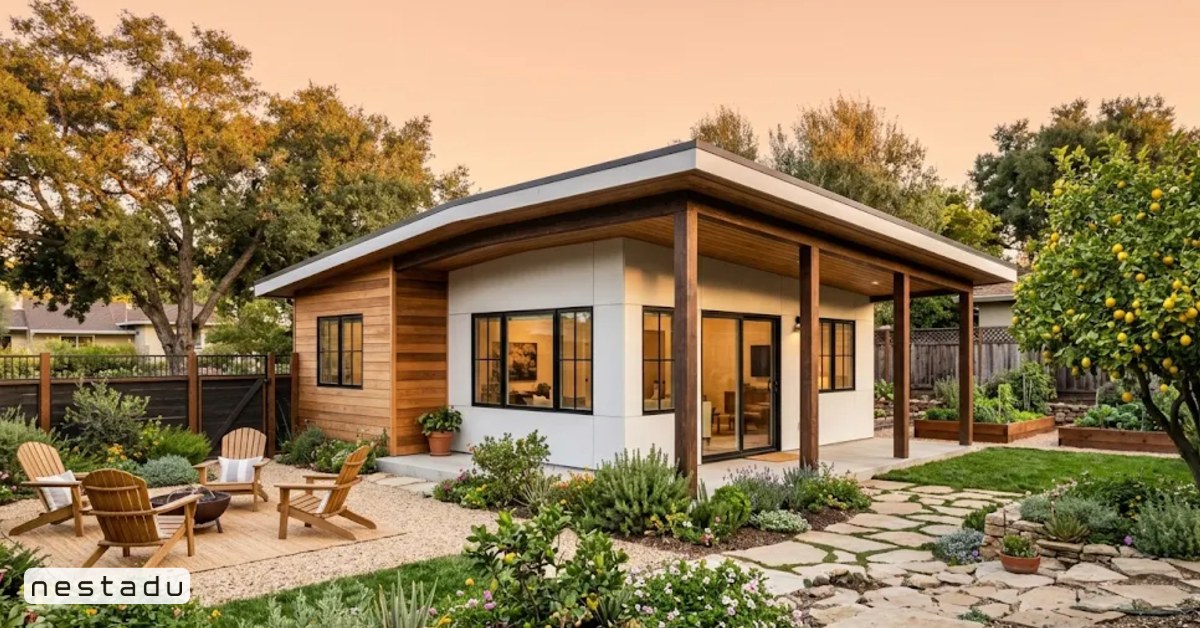
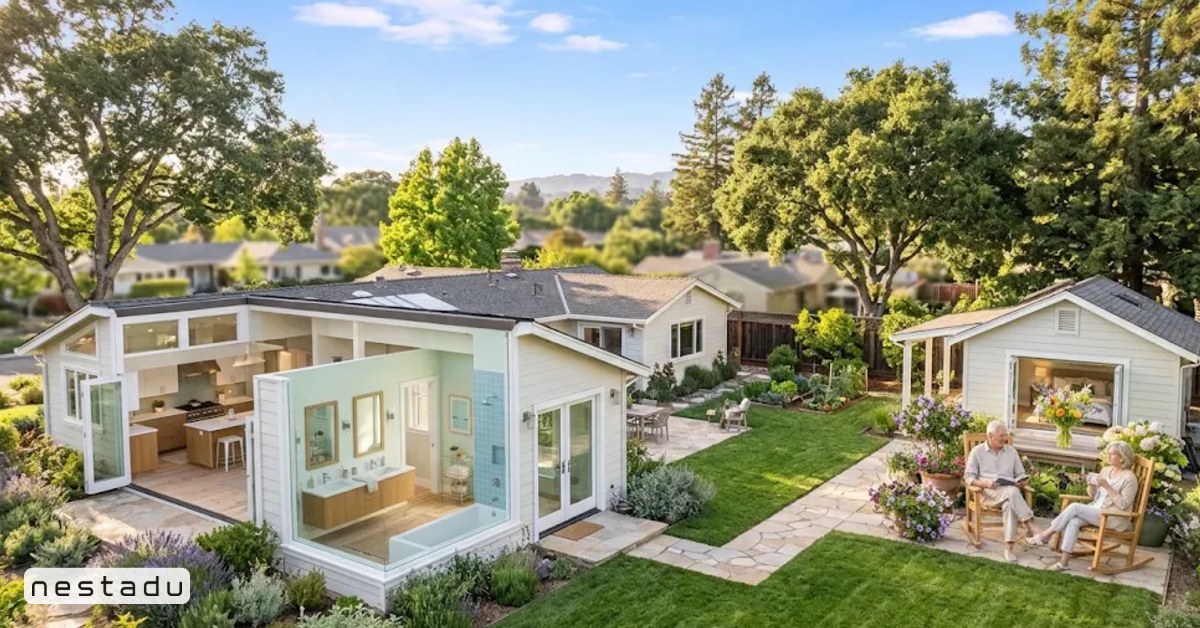
If you have been reading about backyard homes, you may have seen the term DADU and wondered what it means. So, what is a DADU? A DADU is a detached accessory dwelling unit. It is a small, complete home that sits on the same lot as your main house but stands on its own, with no shared walls. Many people call it a backyard cottage, a granny flat or a guest house.
The word DADU is very common in Seattle, Portland and Nashville, where city codes use it. In California, state law simply calls it a detached ADU. The building is the same thing. If you want the basics of the wider ADU family first, our guide on typical ADU sizes is a good place to start.
In this guide, we explain what a DADU is, how California rules treat it, how big it can be, and the most common ways homeowners use one.
What Does DADU Stand For?
DADU stands for Detached Accessory Dwelling Unit. Each word tells you something:
- Detached: the unit is a separate building, not connected to the main house.
- Accessory: it is secondary to the main home on the lot.
- Dwelling Unit: it is a full place to live, with its own entrance, kitchen, bathroom and sleeping area.
That last point matters. A shed with a bed in it is not a DADU. To count as a dwelling unit, the space needs permanent cooking and sanitation facilities and must meet building code for living space. A home office or art studio without a kitchen is usually called an accessory structure instead.
DADU vs ADU: Is There a Difference?
An ADU is the umbrella term. It covers every type of secondary home on a residential lot. A DADU is one type inside that group. Other types include attached ADUs, garage conversions and junior ADUs (JADUs) built inside the main house.
In short, every DADU is an ADU, but not every ADU is a DADU. If you want a full side-by-side comparison of attached and detached units, read our breakdown of the key differences between attached and detached ADUs. For the smallest option inside the home, see how a JADU compares to a standard ADU.
| Term | What it means | Where you hear it |
|---|---|---|
| ADU | Any accessory dwelling unit on a residential lot | Nationwide, including California state law |
| DADU | A detached ADU, a separate building | Seattle, Portland, Nashville and other cities |
| AADU | An attached ADU that shares a wall with the house | Some city codes in the Pacific Northwest |
| JADU | A junior ADU inside the main home, up to 500 sq ft | California |
| Backyard cottage | Everyday name for a DADU | Common in real estate listings |
How California Treats a DADU
California does not use the word DADU in its ADU laws. The state uses “detached accessory dwelling unit” or simply “detached ADU.” So when you apply for a permit in Los Angeles, San Diego, Sacramento or the Bay Area, the city will treat your DADU under the state ADU rules and its local ADU ordinance.
The state sets a floor that cities must allow. Cities can be more generous, but they cannot be stricter than state law on key points. Here are the main rules that typically apply to a detached ADU in California:
- Cities must allow a detached ADU of at least 800 square feet.
- Side and rear setbacks of 4 feet are the most a city can require for that 800 square foot unit.
- Standard height is up to 16 feet, with extra height in some cases, such as lots near transit.
- The state floor for maximum size is 850 square feet for a studio or one bedroom and 1000 square feet for two or more bedrooms. Many cities allow up to 1200 square feet.
- Approval for a qualifying ADU is ministerial, which means staff review it against set standards rather than holding a public hearing.
Local rules still matter for things like design standards, fire access and utility connections. Before you plan, check our guide to ADU setback requirements and your city’s planning page. The state’s official HCD ADU Handbook is also a reliable reference for what cities can and cannot require.
How Big Can a DADU Be in California?
Size is one of the first questions homeowners ask. The answer depends on your lot, your city and the number of bedrooms you want. Here is a simple view of common DADU sizes and what fits in each:
| DADU size | Typical layout | Good for |
|---|---|---|
| 300 to 500 sq ft | Studio with kitchenette and full bath | One person, guest suite, home office with sleeping area |
| 500 to 800 sq ft | One bedroom, one bath | Couples, aging parents, long-term renters |
| 800 to 1,000 sq ft | Two bedrooms, one or two baths | Small families, roommates, higher rent |
| 1,000 to 1,200 sq ft | Two or three bedrooms, two baths | Families, multigenerational living (where the city allows this size) |
Your lot shape, existing trees, easements and utility lines can limit the footprint more than the code does. For a closer look at how cities cap size, see our post on how big an ADU can be in California.
Common Uses for a DADU
Because a DADU is fully separate, it gives more privacy than an attached unit. That makes it flexible. Here are the uses we see most often with California homeowners.
Housing for Family Members
Many families build a DADU so aging parents can live close by while keeping their own space. Others use it for adult children who are saving money. A single-level layout with wide doors and a step-free entry makes the unit easier to live in for years.
Long-Term Rental Income
A detached unit often appeals to renters because there are no shared walls with the owner. That privacy can help with tenant demand. Rents vary a lot by city, size and finishes, so it is smart to check local listings before you set a budget.
Home Office or Studio With Living Space
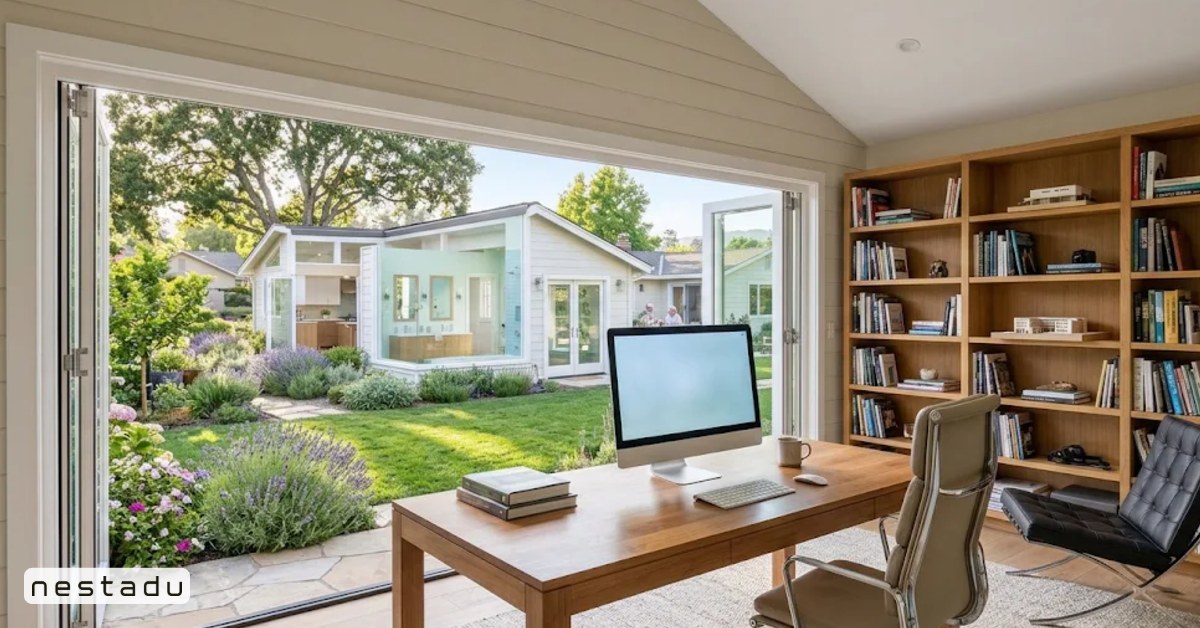
Some owners build a DADU as a work space that can also house guests. Because it has a kitchen and bath, it can switch to a rental or family unit later without major changes.
Downsizing on Your Own Lot
Some homeowners move into the DADU themselves and rent out or hand over the main house. This lets them stay in the neighborhood they know while lowering their own living costs.
Pros and Cons of a DADU
A DADU is not the right fit for every lot. Here is a fair look at both sides.
Pros:
- More privacy for both households
- Less noise moving between units
- Design freedom, since the building does not have to match the house’s structure
- Often stronger rental appeal than an attached unit
Cons:
- Usually costs more than a garage conversion or JADU because it needs its own foundation, roof and utility runs
- Takes up yard space
- Utility trenching can be long on deep lots
- Fire access rules can affect placement on some lots
What Does a DADU Cost in California?
Cost depends on size, site work, finishes and whether you choose a prefab or custom build. Detached units typically cost more per project than conversions because of the new foundation and utility work. Site conditions such as slopes, poor soil or long sewer runs can add a lot.
For a detailed look at current numbers, read our guide to ADU costs in California and our comparison of detached vs attached ADU costs. A site visit is the only way to get a firm price for your property.
Steps to Build a DADU
Most DADU projects in California follow a similar path:
- Feasibility check: review lot size, setbacks, utilities, easements and fire access.
- Design: choose a prefab model or a custom plan that fits your lot and budget.
- Permits: submit plans to your city. Qualifying ADUs get a ministerial review.
- Site work: grading, foundation and utility trenching.
- Construction or installation: framing on site or setting a prefab unit.
- Inspections and final sign-off: the city confirms the unit meets code.
Our guide on getting an ADU permit in California walks through the permit stage in more detail.
DADU FAQs
What does ADU mean in homes?
ADU means accessory dwelling unit. It is a secondary home on the same lot as a main house, with its own kitchen, bathroom and entrance.
Is a DADU the same as a backyard cottage?
Yes, in most cases. “Backyard cottage” is the everyday name, while DADU is the term some city codes use.
Can I sell a DADU separately from my house?
Usually not, but California has created limited paths in some situations. See our post on selling an ADU separately for details.
Is it cheaper to build an ADU or buy a prefab?
A prefab DADU can lower design time and sometimes cost, but site work, foundation and utilities still apply. The total depends on your lot more than the unit itself.
What type of ADU is the cheapest?
A JADU or garage conversion is usually the lowest-cost option because it uses existing walls and roof. A DADU typically costs more but adds the most privacy.
Can an HOA stop me from building a DADU?
California limits how much an HOA can block an ADU, though it may set reasonable rules. Read our guide on HOA rules for ADUs.
Planning Your Detached ADU With Nestadu
Whether you call it a DADU, a backyard cottage or a detached ADU, the goal is the same: a well-built, fully legal home on your lot. Nestadu designs and builds detached ADUs across California, with a focus on the Bay Area, Sacramento, Los Angeles and San Diego. We handle feasibility, design, permits and construction, so you have one team from start to finish.
Ready to see what fits your backyard? Contact our ADU team for a site review.
You can also read client reviews and get directions on Nestadu’s Google profile.
Nestadu
100 Shoreline Hwy, Suite 100, Building B, Mill Valley, CA 94941
Phone: (888) 637-8238
Email: info@nestadu.com
CSLB 1117837 | HCD DL1611393