More California families are adding accessory dwelling units for aging parents, adult children, or rental income. When mobility is part of the picture, a standard ADU layout simply will not work. A stepped entry, a narrow hallway, or a curbed shower can turn a brand new unit into a daily obstacle course.
The good news is that building for wheelchair access is far easier and cheaper when you plan it from the start. This guide walks through every feature that matters, the California rules you should know, the real cost picture, and how Nestadu helps you build it right the first time.
Why a Wheelchair Accessible ADU Makes Sense
An accessible ADU solves several problems at once. It lets aging parents live close to family while keeping their independence and dignity, and it answers California’s strong demand for housing that fits more than one generation under one roof.
It also widens your options down the line. Even if no one in your household uses a wheelchair today, mobility needs change with age, and an accessible unit is far more flexible than a standard one.
The main reasons California homeowners build accessible:
- Multigenerational living that keeps everyone on one property without crowding the main house.
- Stronger rental appeal, since accessible units serve older renters and people with disabilities who struggle to find suitable housing.
- Future proofing, so you never have to tear out walls to adapt the unit later.
An ADU is one of the few chances to design an accessible home from a blank slate instead of fighting an existing floor plan.
Start With the Entry and Approach
The path into the ADU sets the tone for the whole unit. If a wheelchair cannot get through the front door easily, nothing else inside matters, so the goal is a flat, smooth route from the driveway to the main entrance.
A zero-step entry is the gold standard. When the grade makes that impossible, a gentle ramp does the job, as long as it is built to the right slope.
Keep these entry details on your plans:
- Zero-step entry at the main door so a wheelchair rolls straight in.
- Ramps built to the standard 1:12 slope, meaning 12 inches of ramp for every 1 inch of rise.
- Level landings at the top and bottom of every ramp, and on runs longer than 30 feet.
- A firm, slip-resistant approach that stays usable through California’s wet winters.
Doorways, Hallways, and Open Floor Space
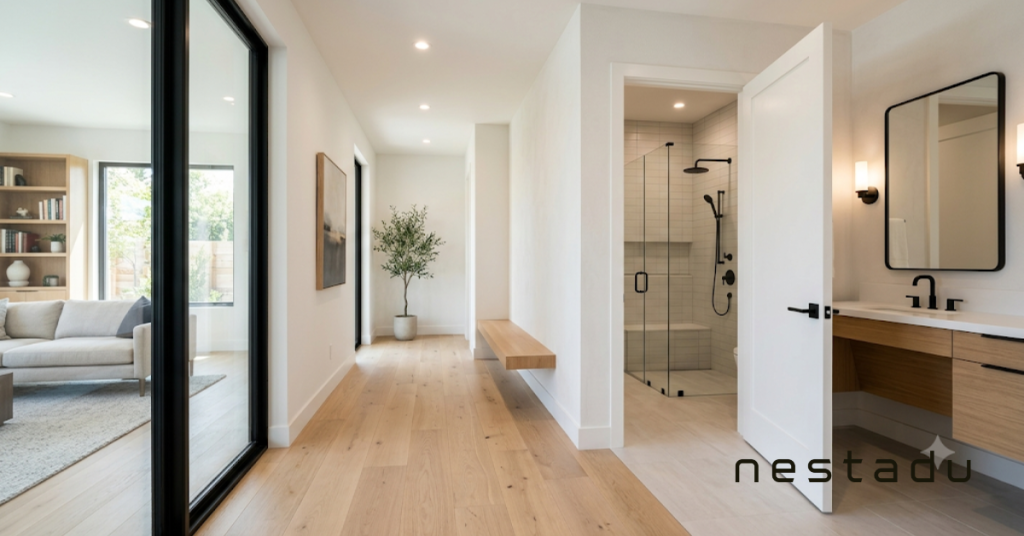
Inside the unit, accessibility comes down to room to move and a layout that does not box a wheelchair into corners. Doorways and hallways are where standard construction usually falls short, so they deserve early attention. Wheelchairs run about 24 to 27 inches wide but need far more clearance to pass through openings and turn, so an open plan beats a chopped up layout.
The clearances to confirm before framing:
- Doorways with at least 32 inches of clear opening, and 34 to 36 inches where you can manage it.
- Thresholds under half an inch, beveled if they rise above a quarter inch.
- Hallways of 36 inches minimum, with 42 to 48 inches preferred for easy turning.
- A 60 inch turning circle in the main rooms so a chair can pivot a full turn without backing up.
- Lever door handles throughout, since they work for people with limited hand strength.
Bathroom Design: The Room to Get Right
The bathroom is the most important room to plan carefully and the most expensive to fix later. Almost every accessible bathroom problem traces back to a curbed shower or a lack of turning space, both simple to avoid during the build.
A curbless, roll-in shower is the heart of the room. Pair it with solid wall backing so grab bars mount securely, since adding that support after the walls are finished is a costly job.
Build these specs into the bathroom:
- Roll-in shower at least 60 by 30 inches with a threshold under half an inch.
- Grab bars mounted 33 to 36 inches above the floor on reinforced walls rated to hold real weight.
- Comfort-height toilet with the seat 17 to 19 inches off the floor and clear space beside it for a side transfer.
- Accessible sink no higher than 34 inches with open knee space below and insulated pipes.
- Handheld showerhead on a long hose that reaches a seated user.
- A 60 inch turning area so the chair can pivot fully inside the room.
Kitchen Design for Seated Use
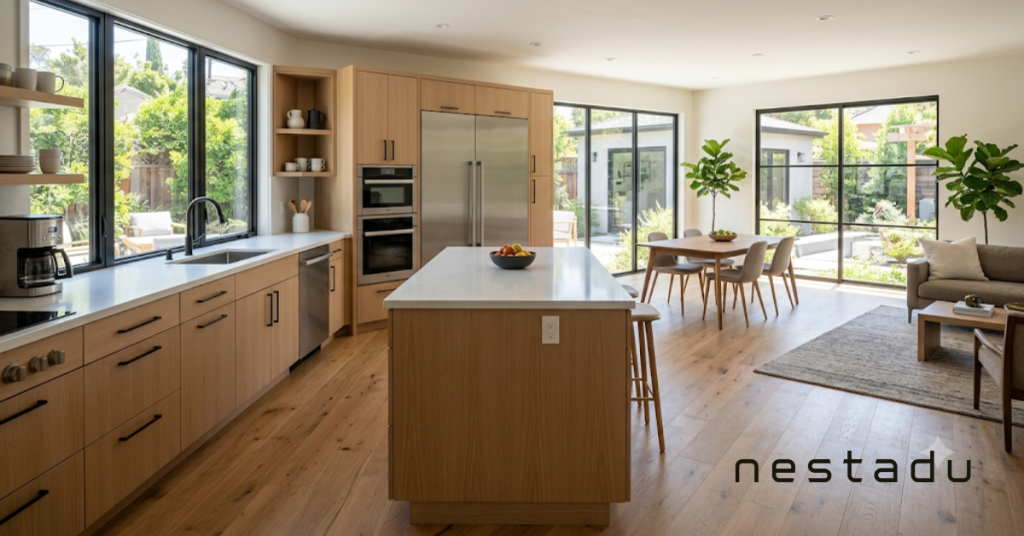
A few targeted changes make the kitchen usable from a seated position without making it feel clinical. The aim is to bring the working surfaces, the sink, and the storage down to a height that a seated person can reach.
Lower a section of counter to around 34 inches and leave open knee space beneath the sink and at least one cooktop area. A side-by-side refrigerator keeps both halves within reach, and pull-out shelving in the lower cabinets removes the need to stand or stretch for everyday items.
Flooring, Lighting, and Fixtures
Small finishing details add up to a safer home. Slip-resistant flooring with flat transitions between rooms prevents the catches and slips that cause most household falls. The rest is about reach and ease of use, all simple to plan upfront:
- Light switches set lower and outlets at least 18 inches off the floor.
- Rocker switches and lever faucets instead of toggles and knobs.
- Even, generous lighting that helps anyone with limited vision move safely.
- Pocket or sliding doors in tight spots to free up floor space.
ADA vs Universal Design: What You Actually Need
This is where many homeowners get confused. The ADA is a civil rights law, and its strict standards apply mostly to public and commercial buildings. A private ADU you build for family is generally not legally required to be ADA compliant.
What you actually want is universal design. This design-for-all approach borrows the useful dimensions from ADA standards and applies them to a private home, so you get wide doors, a roll-in shower, and turning space without being bound to every line of public-building code. The one exception is that renting the unit or running a business from it can bring stricter rules into play.
California Codes and Permits
California layers its own building code on top of the federal rules. The California Building Code Chapter 11A covers private multifamily housing and Chapter 11B covers public housing, and where the two differ, California is usually the more demanding.
For a typical backyard ADU built for family use, you work under the California Residential Code and full ADA compliance is not triggered. Because the code updates every three years and varies by city, the permit stage is where an experienced builder earns their keep. Nestadu builds ADUs across California and manages design, permitting, and construction so accessibility is built in correctly rather than patched on later.
Why Building Accessible From the Start Saves Money
Accessibility features cost far less as part of the original plan than as a later fix. Widening a doorway, pouring a curbless shower pan, or adding wall backing for grab bars is straightforward during construction.
Doing the same work after the unit is finished means tearing out walls, re-plumbing, and repouring concrete, which can run several times the original cost. The smart move is to build the bones for accessibility now even if you do not install every feature yet.
A Quick Checklist Before You Build
Run through these points with your contractor before framing begins:
- Plan for the next 20 years, not just today’s needs.
- Decide early whether the unit will be rented, since that changes the rules.
- Confirm doorway, hallway, and turning clearances on the plans.
- Build in wall reinforcement and a zero-step entry even if features come later.
- Hire an ADU contractor who knows California permitting and accessible design.
Build Your Accessible ADU With Nestadu
A wheelchair accessible ADU is not a special project. It is a well-designed one, and with the right clearances and the bones built in from day one, it serves your family safely for decades.
Nestadu is a California ADU builder focused on transparent pricing and careful craftsmanship, guiding you from concept through completion. If you are planning an accessible in-law suite or backyard cottage, reach out for a design consultation and we will help you build it right the first time.
Frequently Asked Questions
How wide do ADU doorways need to be for a wheelchair?
Plan for at least 32 inches of clear opening, with 34 to 36 inches preferred. Measure the clear space when the door is open, not the frame width.
Is a wheelchair accessible ADU more expensive to build?
Slightly, but far less than retrofitting later. A curbless shower and wide doors add modest cost during construction and avoid expensive demolition down the road.
Can I convert an existing ADU to be wheelchair accessible?
Yes, though it costs more. Common upgrades include widening doors, swapping a curbed shower for a roll-in model, and adding grab bars with proper wall backing.
Do California ADUs need to be ADA compliant?
A private ADU built for family use generally does not. Stricter rules apply mainly to rentals and commercial use, so confirm your situation before you finalize plans.