
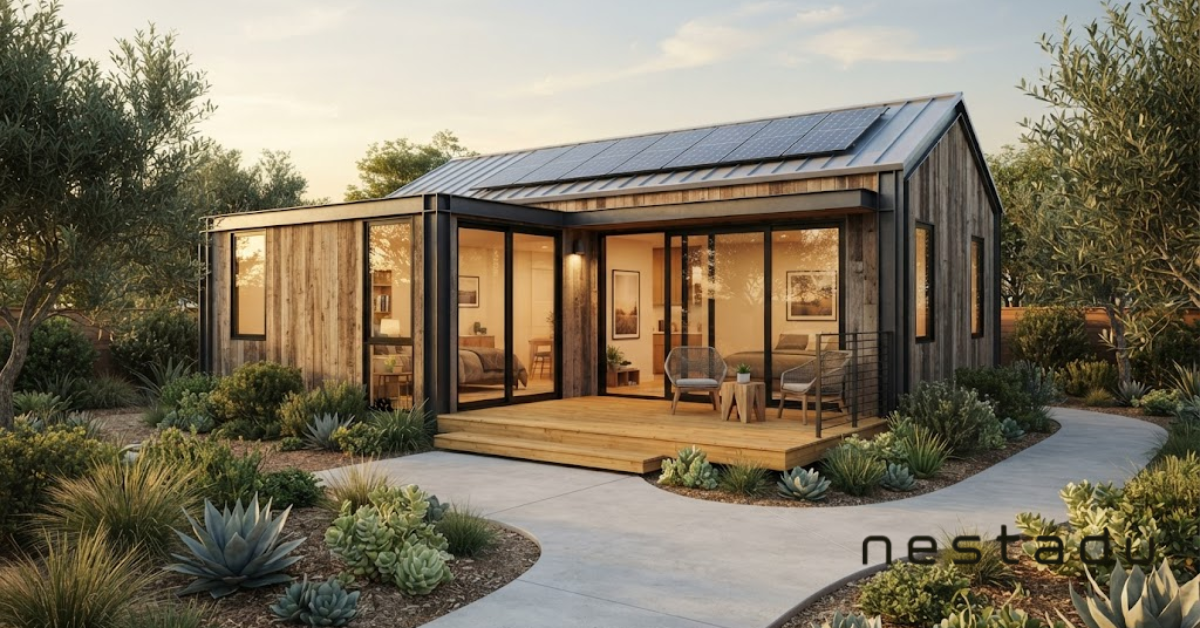
The most practical eco-friendly materials for an ADU are reclaimed or FSC-certified wood, recycled steel framing, structural insulated panels, recycled-content insulation like denim or cellulose, bamboo flooring, low-VOC paints, and cool roofing. These choices lower energy bills, meet California’s CALGreen and Title 24 rules, and hold up better over a 30-year lifespan.
At Nestadu, we build accessory dwelling units across California, and material selection is one of the first conversations we have with homeowners. Here is what actually works, what it costs, and what to skip.
Why Material Choice Hits Harder in an ADU
An ADU is small, usually 400 to 1,200 square feet. That means the building envelope makes up a much larger share of the total structure compared to a main house. A poorly insulated wall in a 600 square foot cottage affects comfort far more than the same wall in a 2,500 square foot home.
Small volume also means indoor air quality is more sensitive. Off-gassing from cheap adhesives and paints concentrates faster in tight spaces, which matters if the unit houses a parent or a long-term tenant.
Reclaimed and FSC-Certified Wood
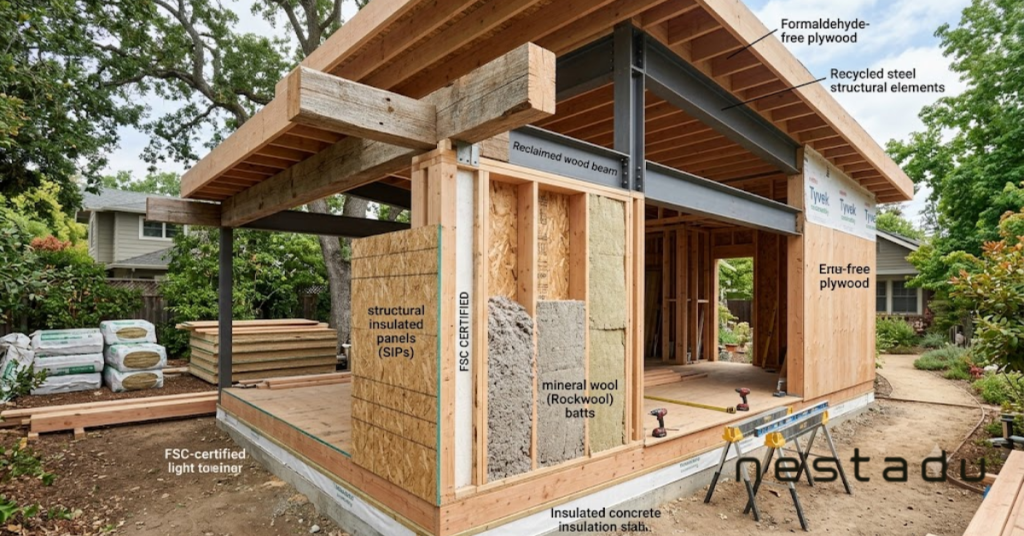
Wood is still the backbone of most ADU builds in California, and the sustainable version is not exotic. Reclaimed lumber comes from old barns, warehouses, and demolished structures, and it is typically denser and more dimensionally stable than new growth timber. FSC-certified wood is new lumber harvested from forests managed under third-party standards.
Where each one fits:
- Reclaimed beams and posts: exposed structural elements, vaulted ceilings
- Reclaimed plank flooring: high-traffic living areas, wide-plank looks
- FSC framing lumber: studs, joists, and rafters where volume is needed
- FSC plywood and OSB: sheathing and subfloor
- Salvaged doors and trim: interior character without new milling
One caution: reclaimed lumber needs to be graded and inspected before it goes into anything structural. Nestadu handles that verification during the design phase so nothing gets flagged at inspection.
Recycled Steel Framing
Steel framing in the United States carries a high recycled content, often above 90 percent for structural sections. For California specifically, steel earns its place because it performs well under seismic load, resists termites, and does not warp or rot.
The tradeoff is thermal bridging. Steel conducts heat, so a steel-framed wall needs continuous exterior insulation to hit Title 24 numbers. Budget for that upfront rather than discovering it at plan check.
Structural Insulated Panels and Recycled Insulation
Structural insulated panels, or SIPs, sandwich a rigid foam core between two sheets of sheathing. They arrive precut, go up fast, and produce a tighter envelope than stick framing with batt insulation. For a small ADU, the labor savings often cancel out the higher material price.
If you stay with conventional framing, the insulation itself is where the biggest sustainability gain sits:
- Recycled denim batts: made from post-industrial cotton, no itch, good sound damping
- Cellulose: roughly 80 percent recycled newsprint, dense-packed into cavities
- Sheep’s wool: naturally moisture regulating and fire resistant
- Mineral wool: made from rock and slag, non-combustible, strong sound blocking
- Hempcrete: carbon-storing infill, best for non-load-bearing walls in mild climates
Required R-values shift depending on which California climate zone you are in. Coastal Zone 3 and inland Zone 12 are not the same assignment, and Nestadu specs insulation against the actual zone rather than a generic number.
Low-VOC Paints, Sealants, and Adhesives
Volatile organic compounds evaporate at room temperature and build up indoors. Standard paints, construction adhesives, and cabinet finishes are common sources. In a compact ADU with less air volume, that concentration climbs faster.
Ask your contractor for products rated at or below 50 g/L VOC for flat paints, and specifically request formaldehyde-free plywood and cabinetry. This is one of the few upgrades that costs almost nothing extra but changes how the unit feels to live in.
Bamboo and Other Renewable Flooring
Bamboo matures in three to five years compared to decades for hardwood, and strand-woven bamboo tests harder than red oak on the Janka scale. It handles the foot traffic of a rental unit well.
Other renewable flooring worth considering:
- Cork: soft underfoot, naturally antimicrobial, good for bedrooms
- Linoleum: made from linseed oil and jute, not to be confused with vinyl
- Reclaimed hardwood: already-harvested wood with proven stability
- Recycled-content porcelain tile: durable in kitchens and bathrooms
Confirm that bamboo or cork products use formaldehyde-free adhesives, since the binder can undo the health benefit of the material.
Cool Roofing and Solar-Ready Design
New ADUs in California are increasingly built solar-ready, and roofing choice affects both cooling load and panel performance. Cool roofing uses reflective coatings or light-colored materials to bounce solar radiation instead of absorbing it, which cuts attic temperatures during inland summers.
Metal roofing with a reflective finish, clay tile, and recycled composite shingles all work. Whichever you pick, plan panel layout and conduit runs during design rather than retrofitting later.
Water and Surface Materials That Reduce Waste
Water efficiency is part of the sustainability picture, especially in a state that cycles through drought. Nestadu specs WaterSense-labeled fixtures as standard, and rough-in for greywater reuse is a small add during construction that becomes expensive after the fact.
Good options for surfaces and fixtures:
- Recycled glass or paper composite countertops
- Low-flow showerheads rated at 1.8 GPM or less
- Dual-flush or 1.28 GPF toilets
- Tile with post-consumer recycled content
- Permeable pavers for walkways and patios
What This Actually Costs
Not every green material adds cost. Low-VOC paint, recycled-content tile, and WaterSense fixtures are close to price-neutral. Cellulose and denim insulation sit within a few percent of fiberglass. SIPs, recycled steel, and reclaimed timber carry a real premium, often 5 to 15 percent on those line items.
The payback comes from three places: lower monthly utility costs, a rent premium for units that stay comfortable year-round, and fewer replacement cycles because the materials last longer. For a rental ADU, that math usually closes inside a decade.
Choosing Materials That Fit Your Property
There is no universal green spec sheet. A shaded backyard in Berkeley and a west-facing lot in Fresno call for different insulation, glazing, and roofing decisions. Budget matters too. If you can only upgrade in a few places, put the money into the envelope and the air quality products, because those are the hardest things to change once the drywall goes up.
Build a Greener ADU with Nestadu
Nestadu designs and builds ADUs across California with material plans written against your climate zone, your budget, and current CALGreen and Title 24 requirements. We handle permitting, sourcing, and construction so the sustainable choices actually make it into the finished unit instead of getting cut during value engineering.
Reach out for a consultation and we will walk your property, talk through material options, and give you transparent pricing before anything gets ordered.
Frequently Asked Questions
Are eco-friendly ADU materials more expensive?
Some are and some are not. Low-VOC finishes, recycled-content tile, and efficient fixtures cost about the same as standard products. SIPs, recycled steel, and reclaimed timber run 5 to 15 percent higher on those items, offset over time by lower energy bills.
Does California require green materials for ADUs?
California requires compliance with the CALGreen code and Title 24 energy standards, which set minimums for insulation, water efficiency, and low-emission materials. Specific products are not mandated, but the performance targets push you toward efficient choices.
What is the most sustainable insulation for an ADU?
Cellulose and recycled denim offer high recycled content at a reasonable price. Sheep’s wool and mineral wool perform well where moisture control or fire resistance is a priority.
Can an ADU be built entirely from recycled materials?
Not entirely, since structural connectors, electrical, and plumbing components generally need to be new for code compliance. A large share of framing, insulation, flooring, and finishes can be recycled or reclaimed.