
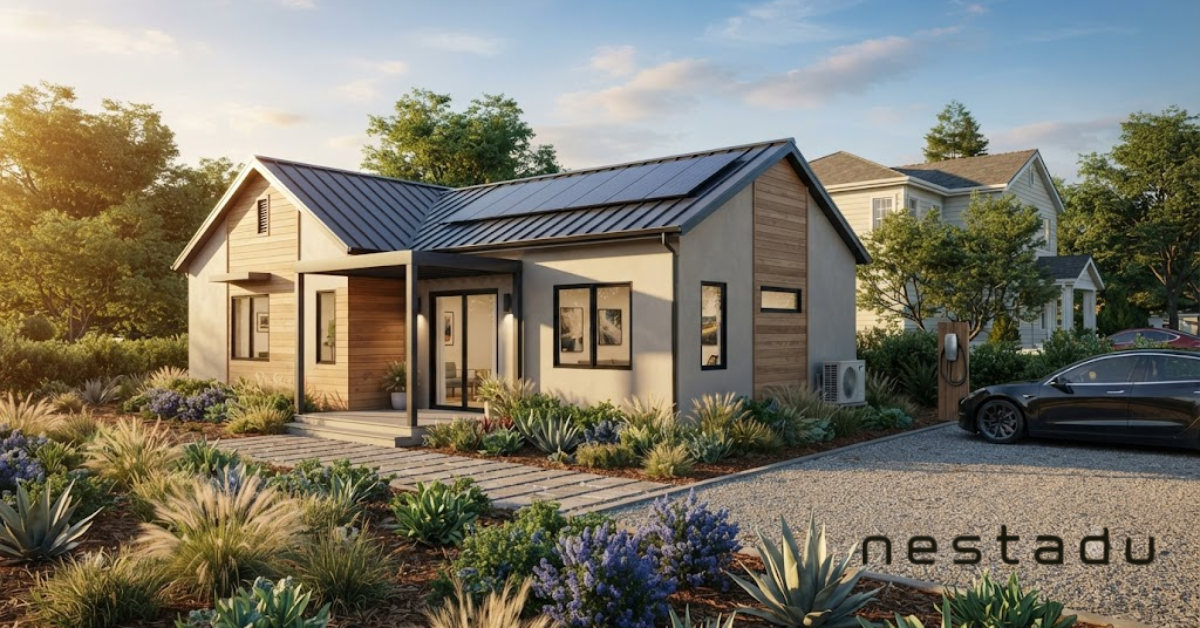
Yes, but the honest 2026 answer is more complicated than most articles admit. Federal solar and heat pump tax credits expired on December 31, 2025. California’s biggest statewide rebate pools are fully reserved. What is left is a smaller, more local set of programs, plus code requirements that quietly save you money over the life of the unit.
At Nestadu, we walk homeowners through this before a single drawing gets made, because budgeting an ADU around a rebate that no longer exists is one of the fastest ways to blow up a project.
Why California Treats ADUs as Green Buildings
California’s building energy code, Title 24, classifies most accessory dwelling units as new construction. That means your backyard cottage or in-law suite has to meet the same energy standards as a brand new house.
The 2025 code cycle took effect on January 1, 2026. If you pull a permit today, you are under those rules, and they push ADUs toward all-electric systems by default.
Solar on Your ADU: Required, But Not Always
The most misunderstood rule in California ADU construction is the solar mandate. A newly built, detached, site-built ADU generally needs a photovoltaic system as part of the permit. But plenty of projects never trigger it.
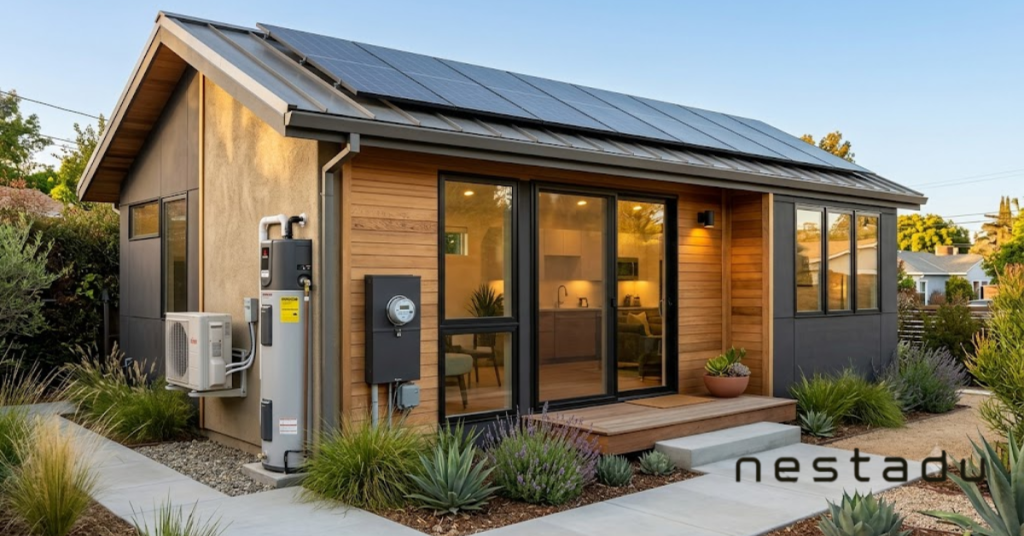
Your ADU is likely exempt from the solar requirement if:
- It is a garage conversion, basement conversion, or attic conversion (treated as an alteration, not new construction)
- It is an attached ADU sharing a wall with the main house (counts as an addition)
- It is a Junior ADU built inside the existing home
- It is a factory-built or manufactured unit set on a foundation
- The calculated system size falls below 1.8 kW, which in practice covers many detached units around 600 to 700 square feet depending on climate zone
- The roof has less than 80 contiguous square feet of usable solar access due to shading or orientation
If solar is required, you also do not have to put the panels on the ADU itself. The California Energy Commission allows the array to sit on the primary residence, as long as it is on the same lot and included in the ADU permit application. Homeowners who already have solar can often just expand the existing system.
What Actually Happened to the Rebates in 2026
This is where most ADU blogs are out of date, and where you should be careful. A lot of the programs still being advertised online are closed.
| Program | Status in 2026 |
| Federal 25C and 25D tax credits | Expired December 31, 2025 |
| HEEHRA single family rebates | Fully reserved statewide, waitlist only |
| TECH Clean California (single family) | Fully reserved |
| SGIP general market and equity budgets | Closed to new applicants |
| California Energy Smart Homes | 2026 funding fully subscribed |
| SMUD and LADWP utility rebates | Active |
| GoGreen Home financing | Active statewide |
The lesson is simple. Never sign a construction contract that assumes a rebate you have not already reserved in writing. Ask for a reservation number, not a promise.
Incentives Still Worth Pursuing
There is still money on the table, it just depends heavily on who runs your electric meter and which water district you fall under. This is the part of the process where Nestadu clients tend to find savings they did not know existed.
Programs that remain accessible for many California homeowners:
- SMUD rebates for Sacramento area homes, including heat pump conversions and battery incentives through My Energy Optimizer
- LADWP consumer rebates covering high efficiency ductless heat pumps and heat pump water heaters, with no income qualification
- SGIP RSSE battery pathway for income qualified households, high fire threat districts, PSPS affected areas, and medical baseline customers (waitlist)
- Local water district rebates for high efficiency fixtures, greywater systems, and turf replacement around the new unit
- GoGreen Home Energy Financing, low interest loans available regardless of utility
Water rebates get overlooked constantly. Districts across the state still fund turf removal and efficient landscaping, and an ADU build is the natural moment to redo the yard anyway.
The Incentives Hiding in Plain Sight
Some of the strongest financial upside for an ADU is not labeled as an environmental program at all. It comes from how California structures fees and taxes.
Under SB 13, ADUs under 750 square feet are exempt from impact fees, which can otherwise run into thousands of dollars. That single rule is often worth more than any active rebate right now.
Property tax treatment is also friendlier than people expect:
- Only the added value of the ADU gets assessed. Your primary home is not reassessed at current market value
- Solar systems are excluded from property tax assessment in California
- The ADU keeps its own separate value line, so your existing Prop 13 basis stays intact
Lower Bills Are the Real Long Term Payoff
Under the 2025 code, heat pump water heaters are now the prescriptive baseline for new detached ADUs. Paired with heat pump HVAC and tight insulation, that produces a unit that costs very little to run.
For a rental ADU, this matters twice over. Your operating costs stay low, and a tenant looking at rising SCE or PG&E rates will pay a premium for a small, efficient, all-electric home.
The Environmental Incentives Beyond the Paperwork
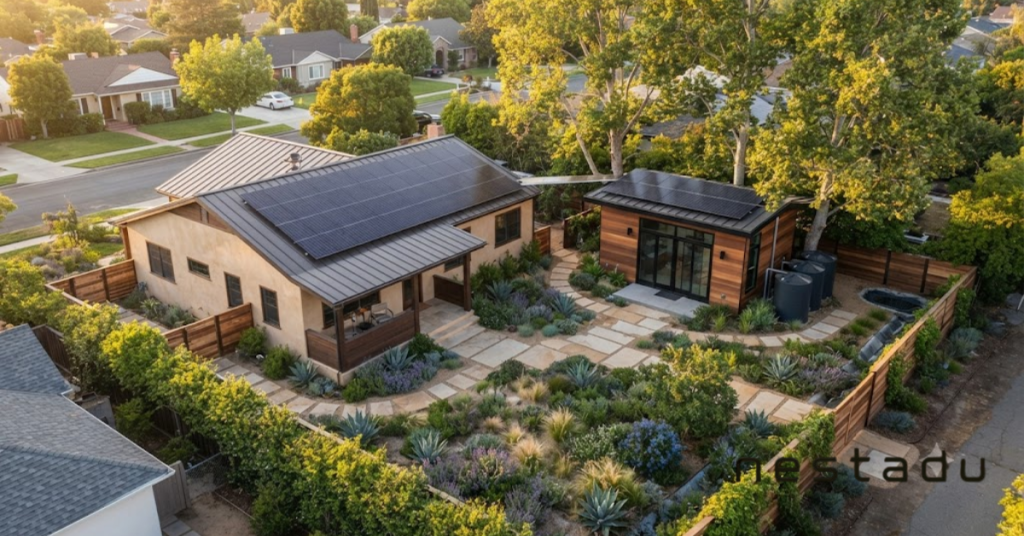
ADUs are infill housing. They use land, sewer lines, water mains, and roads that already exist, which avoids the emissions cost of building new infrastructure at the edge of a city.
A well built ADU is also small by definition. Less conditioned space means less energy per resident, and units built near existing jobs and transit cut commute distances in a way no rebate ever could.
Build It Right the First Time With Nestadu
The incentive landscape in California shifts every few months. Code requirements do not. The homeowners who come out ahead are the ones who design for efficiency at the start rather than bolting it on after the permit is issued.
Nestadu handles Title 24 review, solar exemption analysis, and rebate eligibility as part of the planning phase, so you know what your ADU will actually cost and what it will actually save. If you are weighing a backyard cottage, in-law suite, or garage conversion anywhere in California, reach out for a project consultation and we will map the real numbers for your lot.