
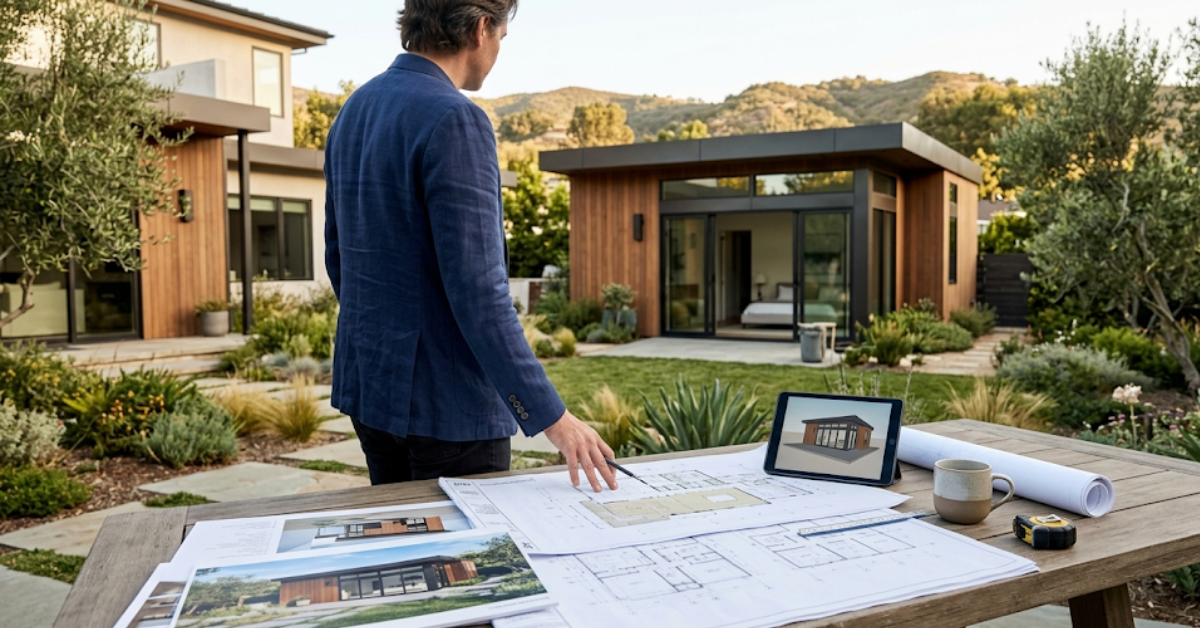
It is one of the first questions California homeowners ask before breaking ground on an ADU. The assumption is that you need an architect before anything else can happen. In most cases, that is simply not true.
California does not legally require a licensed architect for ADU projects. But there are specific situations where one is necessary and others where hiring one just adds cost. Nestadu helps homeowners make this call on every project, and the answer almost always comes down to your ADU type, lot complexity, and design approach.
What an Architect Actually Does for an ADU Project
An architect’s role on an ADU project goes well beyond drawing a floor plan. They handle the full design process from initial concept through construction-ready documents. But for most residential ADUs in California, a qualified designer or a design-build firm can handle all of this without a licensed architect.
Here is what an architect typically covers on an ADU project:
- Creating detailed construction drawings and blueprints that meet local building codes and zoning rules
- Designing the unit’s layout, flow, and aesthetic to complement your existing property
- Coordinating with structural, mechanical, and electrical engineers for the technical portions of the plans
- Managing zoning compliance for setbacks, height limits, lot coverage, and parking requirements
- Preparing and submitting plans to the local building department for permit review
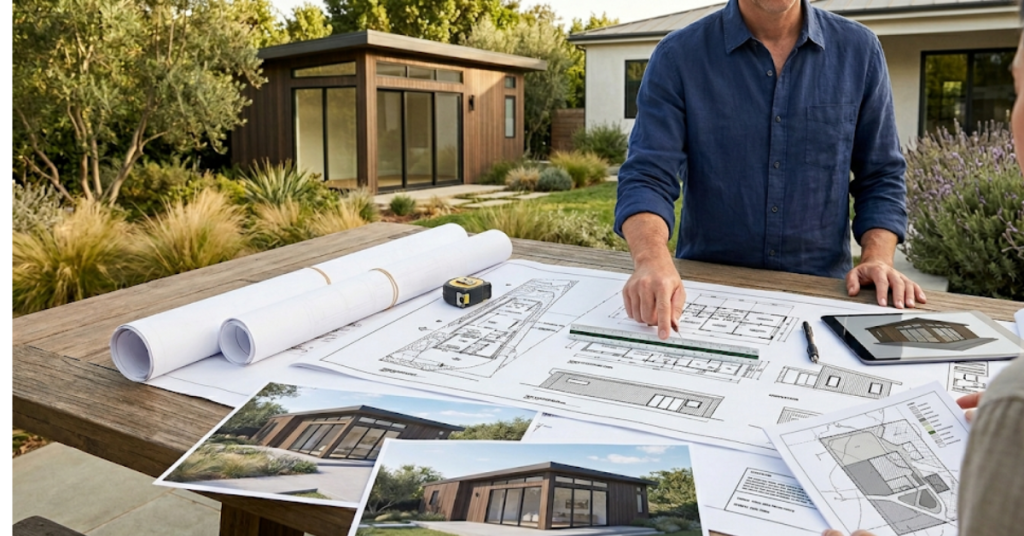
There is an important distinction most homeowners miss. A designer or draftsperson can prepare the same construction drawings for most residential ADU projects. An architect’s licensed stamp is only legally required in specific situations defined by state law. Understanding when that stamp is and is not needed can save you thousands of dollars before the project even starts.
When California Law Requires an Architect
Under California’s Business and Professions Code, a licensed architect must stamp plans for residential structures taller than two stories. Since California ADU laws cap accessory dwelling units at two stories, the vast majority of ADU projects fall outside this requirement entirely.
There are a few exceptions where an architect is legally required or strongly recommended:
- More than four dwelling units on one lot. If adding an ADU brings the total number of units on your property above four, state law requires architect-prepared plans regardless of the building’s height.
- Historic Preservation Overlay Zones (HPOZs). Neighborhoods with historic design review, particularly in cities like Los Angeles (West Adams, Hancock Park, Angelino Heights, Windsor Square, and 30+ others), often need architect involvement to navigate the review board approval process.
- Major structural modifications. Some local building departments will flag projects with significant structural changes and request architect-stamped plans even when not strictly mandated by state law. This is more common with two-story ADUs or projects that involve substantial changes to the existing home.
- Complex site conditions. Properties on steep hillsides, in flood zones, in high fire severity areas, or with unusual soil conditions sometimes require the level of design coordination that only a licensed architect can provide.
For the vast majority of single-family ADU projects in California, whether it is a detached backyard cottage, an attached addition, or a garage conversion, an architect is not legally necessary. However, a structural engineer is required in almost every case to review and stamp the structural portion of your plans.
When You Can Skip the Architect Entirely
There are several common scenarios where hiring an architect adds cost and time without meaningfully improving the outcome. Knowing when to skip this step can save you $8,000 to $25,000 in design fees alone.
Pre-approved ADU plans. Many California cities now offer pre-approved ADU plan sets that homeowners can use for free or at a very low cost. Sacramento County, the City of Los Angeles, San Jose, and dozens of other jurisdictions provide these ready-to-go plans. They have already been reviewed for code compliance, which means you skip most of the design phase entirely and go straight to permit application.
Design-build firms like Nestadu. When one company handles design, engineering, permits, and construction in-house, there is no need for a separate architect. Nestadu’s team creates custom ADU designs, coordinates structural and mechanical engineering, and manages the full permit process under one roof. This is the most common and cost-effective approach for ADU projects in California today.
Simple garage conversions and JADUs. These projects convert existing space rather than building new structures from the ground up. A qualified designer and structural engineer can handle the construction drawings without architect involvement. The plans are simpler, the permitting process is faster, and the design fees are significantly lower.
Prefab and modular ADUs. Factory-built units come with manufacturer-provided plans that are already engineered and tested. Site-specific adjustments for foundations, utility connections, and local code compliance may be needed, but an architect is rarely part of this process.
Architect vs Design-Build: Which Path Makes More Sense?
This is where most homeowners get stuck. They assume hiring an architect is step one, when in reality, the design-build approach is faster, cheaper, and better coordinated for the majority of ADU projects.
The architect route works like this: you hire one firm for design, which costs $6,000 to $25,000+ and takes 4 to 12 weeks. Once you have plans in hand, you then need to find a separate general contractor to build it. The architect and contractor may disagree on what is buildable within your budget, which leads to redesigns, delays, and change orders. You end up managing two separate teams who may not communicate well with each other.
The design-build route puts everything under one team from start to finish. Nestadu handles design, engineering, permits, and construction together, which means the plans are buildable from day one. There is no communication gap between separate firms, no surprise cost increases from misaligned expectations, and no wasted weeks waiting for handoffs between design and construction teams.
The savings add up quickly. Most homeowners who choose the design-build path over a standalone architect save $8,000 to $20,000 in soft costs and cut several weeks off their total project timeline. That time savings also means you start collecting rental income or using your new space sooner.
How Much Does an ADU Architect Cost in California?
If you do decide to hire a standalone architect, here is what the numbers look like in 2026. These are design fees only and do not include the cost of construction.

- Basic ADU plans (standard layouts, minimal customization): $6,000 to $12,000
- Custom ADU designs (unique floor plans, site-specific solutions): $14,000 to $25,000+
- Percentage-based fees: Some architects charge 8% to 15% of total construction cost. On a $250,000 ADU build, that translates to $20,000 to $37,500 for design alone.
These fees typically do not include structural engineering, Title 24 energy compliance reports, soil or geotechnical reports, or civil engineering. Those additional consultants can add another $3,000 to $8,000 on top of the architect’s bill, bringing your total soft costs to $15,000 to $30,000+ before construction begins.
It is also worth noting that architect fees are often just the starting point. Revisions, plan check corrections, and additional coordination with engineers can push the final design cost well beyond the initial quote.
When Hiring an Architect is Actually Worth It
Despite the cost and timeline, there are real situations where an architect earns their fee and then some. The value shows up most clearly on projects where standard plans simply will not work.
- Hillside or complex lots with steep slopes, unusual soil conditions, or tight access where standard designs need significant modification to work safely
- Two-story ADUs where structural, mechanical, and aesthetic decisions are more complex and need careful coordination between multiple engineering disciplines
- High-end custom builds where the ADU needs to match an architecturally significant main home with specific materials, roof lines, or design details
- Properties in design-review zones like HPOZs, planned communities, or coastal areas that require formal approval from a review board before permits are issued
For straightforward single-story detached ADUs, garage conversions, JADUs, and standard attached units on flat lots, an architect is an added expense that does not change the final outcome in any meaningful way.
How Nestadu Handles ADU Design Without the Extra Cost
Nestadu’s in-house design team handles architecture, structural engineering, and permit coordination as part of every project. There is no need to hire a separate architect, find your own engineer, or manage multiple vendors who may not be aligned with each other.
Every Nestadu ADU is custom-designed to fit your property and complement your existing home. The design and construction teams work side by side from day one, which means buildable plans, no costly redesigns mid-project, and a faster path from concept to completion. If you are ready to explore your ADU options, talk to the Nestadu team to get a clear picture of what is possible on your property.