
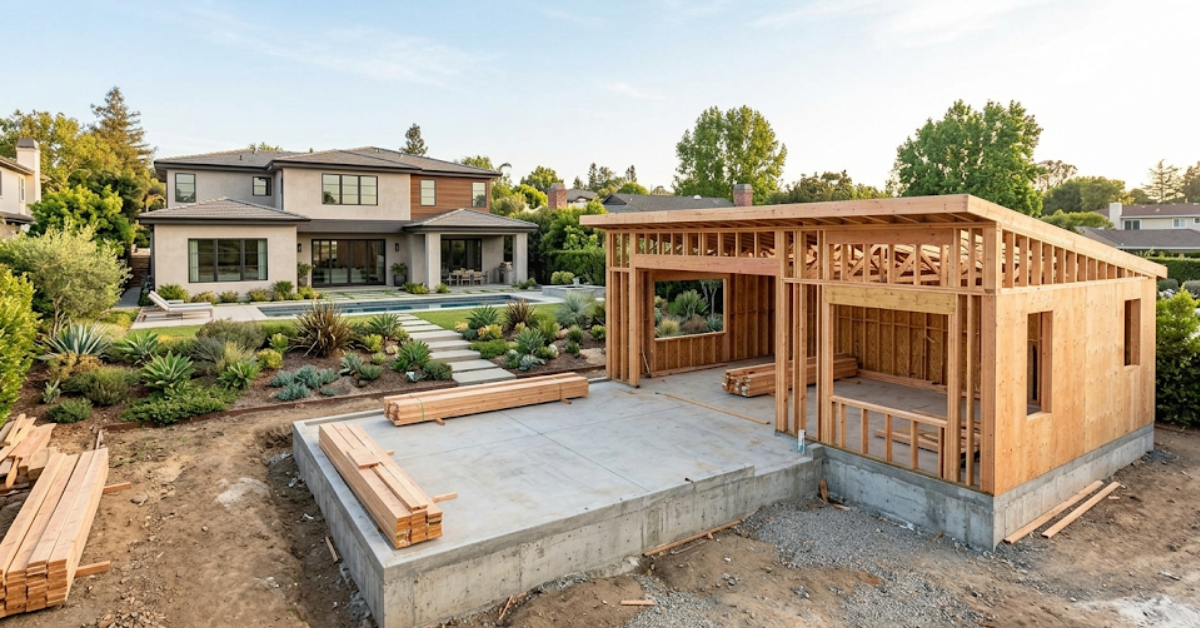
If you are planning to build an accessory dwelling unit on your California property, one of the first structural questions you will face is whether your ADU needs its own foundation. The answer, in almost every case, is yes. California building codes require ADUs to sit on a permanent foundation, regardless of whether the unit is prefab, modular, or site-built.
But “separate foundation” does not always mean the same thing for every project. The type of foundation your ADU requires depends on your lot conditions, the style of ADU you are building, and your local municipality’s specific requirements. This guide covers what California homeowners need to know about ADU foundations before breaking ground.
Why Most ADUs Require Their Own Foundation
Every habitable structure in California must meet the California Building Code (CBC), and that includes accessory dwelling units. A permanent foundation is required for structural integrity, seismic safety, proper utility connections, and long-term durability. You cannot place a permitted ADU on temporary supports, cinder blocks, or an unprepared surface and expect it to pass inspection.
The foundation serves several critical functions beyond keeping the structure level. It anchors the ADU against seismic movement, prevents moisture intrusion, provides pathways for plumbing and electrical, and distributes the building’s weight evenly across the soil. Without a proper foundation, no ADU will pass required inspections in any California jurisdiction.

The one partial exception is attached ADUs that tie into the existing home’s structure. In some cases, the original home’s foundation may support the addition, but this requires a structural engineer’s assessment and approval from the local building department.
Types of Foundations Used for ADUs in California
Not all ADU foundations are the same. The right type depends on your soil conditions, lot slope, ADU size, and budget. Here are the most common options California builders work with.
Slab-on-Grade
This is the most widely used foundation for ADUs in California, especially for prefab units and smaller detached builds. A slab-on-grade foundation involves pouring a single layer of concrete directly on prepared, leveled ground. It is cost-effective, fast to install, and works well on flat or gently sloped lots.
- Typical cost range: $5,000 to $15,000 depending on ADU size and soil conditions
- Best suited for flat lots with stable soil
- Allows for radiant floor heating to be embedded directly into the slab
- Requires proper vapor barriers and rebar reinforcement per CBC standards
Stem Wall (Raised Foundation)
A stem wall foundation raises the ADU above ground level using short concrete walls that sit on top of footings. This creates a small crawl space between the ground and the floor of the unit, which provides easier access to plumbing and electrical systems after construction.
- Costs more than slab-on-grade due to additional concrete pours and forming
- Preferred on lots with mild slopes or drainage concerns
- Provides better ventilation and moisture protection in areas with high water tables
- Requires more precise engineering and additional inspection steps
Pier and Beam
Pier and beam foundations use concrete piers drilled deep into the ground with beams spanning between them to support the structure above. This method is effective for lots with uneven terrain, poor soil conditions, or significant slopes where a flat slab is not practical.
- Works well on hillside properties or lots with challenging topography
- Allows the ADU to be built above grade without extensive excavation
- Provides full access to utilities beneath the structure
- Higher cost than slab-on-grade and requires detailed engineering based on soil reports
Hybrid Foundations
In some situations, a single foundation type is not enough. A builder may use a combination, for example, a slab-on-grade on one side and a raised stem wall on another to account for uneven ground. Hybrid foundations are more complex and require careful structural engineering, but they solve problems that no single foundation type can handle alone.
How Foundation Needs Change by ADU Type
The type of ADU you are building directly affects what kind of foundation work is involved. Here is how it breaks down.
Detached ADUs always need a completely separate, new foundation. There is no existing structure to tie into, so the foundation must be built from scratch based on soil reports and engineering plans.
Attached ADUs may be able to connect to the primary home’s existing foundation in some cases, but this requires a structural engineer to verify that the original foundation can handle the additional load. Most attached ADUs still need some new foundation work, even if part of the existing structure is used.
Prefab ADUs are factory-built and delivered to your property, but the foundation must be prepared before the unit arrives. The foundation specs are typically provided by the prefab manufacturer, and the on-site contractor handles the pour and curing before delivery day. If the foundation is not ready and properly cured, the installation gets delayed.
Garage conversions are a gray area. The existing garage slab may work as a foundation in some cases, but it often does not meet current building code requirements for a habitable dwelling. Many garage slabs lack proper vapor barriers, rebar reinforcement, or adequate thickness. A structural engineer will need to assess whether the slab can be used as-is, reinforced, or replaced entirely.
What Drives ADU Foundation Costs in California
Foundation work is one of the more variable cost items in an ADU project. Several factors determine where your project lands on the price spectrum.
- Soil conditions. Poor or unstable soil may require deeper footings, soil compaction, or even soil removal and replacement before the foundation can be poured. A geotechnical soil report (typically $1,500 to $3,000) is often required before work begins.
- Lot slope and grading. Flat lots are cheaper to work with. Sloped or uneven properties can increase foundation costs by 20 to 30 percent due to additional excavation, retaining walls, or stepped footings.
- ADU size. A larger footprint means more concrete, more rebar, and more labor. A 200 sq. ft. studio ADU foundation costs significantly less than an 800 sq. ft. two-bedroom unit.
- Utility trenching. Sewer, water, and electrical connections need to run from the main house to the ADU. Trenching for these utilities is typically done alongside foundation work and can add $5,000 to $15,000 to the project.
- Permit and inspection fees. Foundation pours require their own inspections, including rebar placement checks and concrete testing. These fees are usually rolled into the overall ADU permit cost, which ranges from $2,000 to $8,000 in most California cities.
For most California ADU projects, total foundation costs fall between $5,000 and $20,000, with complex sites pushing higher.
How Nestadu Handles ADU Foundation Work
At Nestadu, foundation preparation is built into the full-service ADU construction process. It is not treated as a separate project that homeowners need to manage on their own. From the initial site assessment, Nestadu’s team evaluates your lot conditions, soil type, slope, and access points to determine the right foundation approach for your specific property.
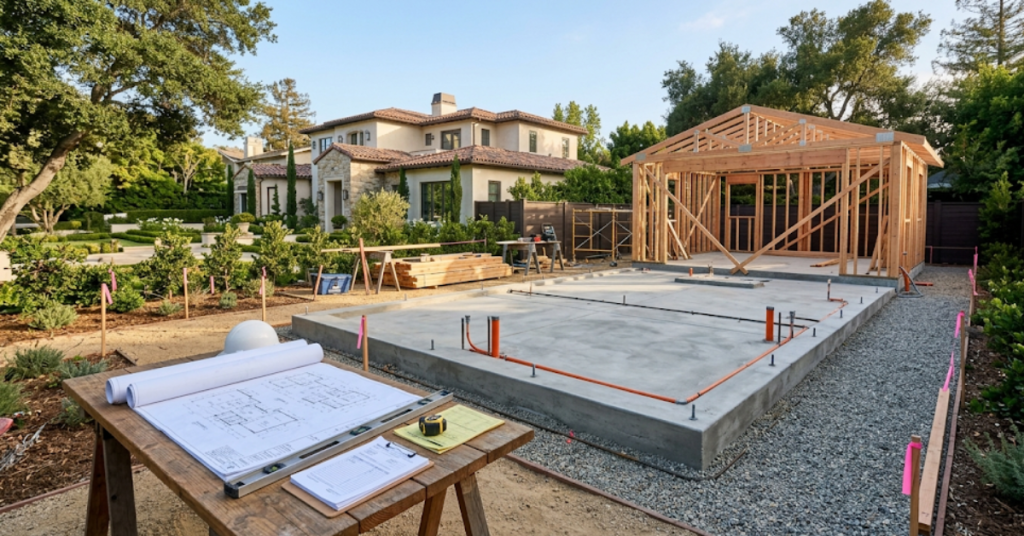
For prefab ADU projects, Nestadu coordinates the foundation timeline so it is poured, cured, and inspection-approved before your unit arrives for installation. For custom site-built ADUs, the foundation is engineered as part of the overall structural design, with all permits and inspections handled in-house.
This matters because foundation issues are one of the most common sources of ADU project delays. When foundation work is managed separately, miscommunication between contractors leads to scheduling gaps and cost overruns. Nestadu eliminates that by keeping everything under one team across 100+ California cities.
Common Questions About ADU Foundations
Can I pour my own ADU foundation? Technically, owner-builder permits exist in California, but foundation work requires precise engineering, proper rebar placement, code-compliant concrete mixes, and multiple inspections. Mistakes in foundation work are extremely expensive to fix after the fact. Most homeowners are better off leaving this to a licensed contractor.
How long does ADU foundation work take? For a standard slab-on-grade on a flat lot, expect 1 to 2 weeks for excavation, forming, pouring, and curing. More complex foundations can take 3 to 4 weeks. Concrete typically needs 7 to 28 days to reach full strength before construction continues on top of it.
Does foundation type affect property value? Yes. A permanent, code-compliant foundation is required for the ADU to be considered a legal dwelling unit. ADUs on proper foundations add real appraised value to your property, while unpermitted structures on temporary supports do not.
Getting Your ADU Foundation Right the First Time
Foundation work is not the most visible part of an ADU project, but it is arguably the most important. Every decision that follows depends on what is underneath the structure. Getting it wrong is costly. Getting it right sets the entire project up for success.
If you are considering an ADU in California, Nestadu can assess your property, recommend the right foundation type, and manage the entire build. Schedule a consultation to get started.