
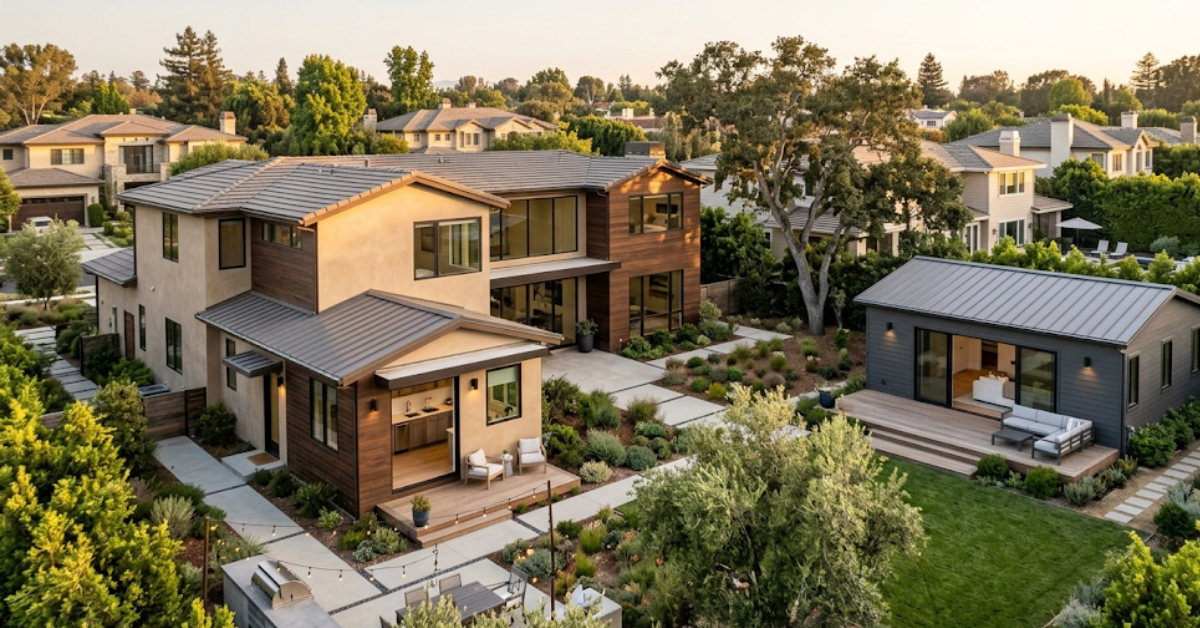
California gives homeowners two distinct ways to add a secondary living unit to their property. One is a standard ADU (Accessory Dwelling Unit), and the other is a JADU (Junior Accessory Dwelling Unit). They sound similar, but the differences in size, cost, construction, and regulations are significant enough to change your entire project plan.
Choosing the wrong one can cost you tens of thousands of dollars or limit how you use the space. Nestadu works with California homeowners on both JADU and a Standard ADU projects, and the first conversation almost always starts with this exact question. Here is a clear breakdown of how these two options compare and which one makes sense for your situation.
What is a Standard ADU?
A standard ADU is a fully independent living unit built on a single-family residential lot. It has its own kitchen, bathroom, living area, and separate entrance. Think of it as a small standalone home on your property.
Standard ADUs come in three main forms:
- Detached ADU is a completely separate structure built in the backyard, often called a backyard cottage or guest house. It offers the most privacy and typically adds the highest resale value.
- Attached ADU is an addition built onto the main house with its own entrance. It shares a wall with your home but functions as an independent unit.
- Garage conversion takes an existing garage and converts it into a livable unit with a full kitchen and bathroom.
Under California law, standard ADUs can be up to 1,200 square feet depending on local regulations. They require their own full kitchen and bathroom, and in most cases, they need separate or sub-metered utility connections. The typical cost to build a standard ADU in California ranges from $150,000 to $350,000 depending on size, type, and site conditions.
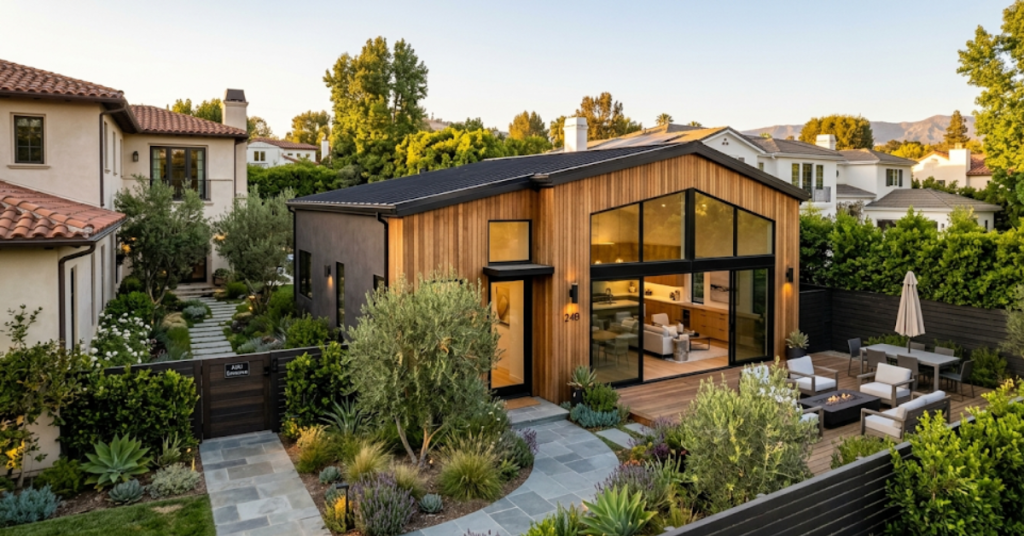
One major advantage of standard ADUs: there is no owner-occupancy requirement. Since AB 976 took effect on January 1, 2025, California permanently removed the requirement for property owners to live on-site when building a standard ADU. You can rent out both the main home and the ADU while living elsewhere.
What is a JADU (Junior Accessory Dwelling Unit)?
A JADU is a smaller, more compact living unit that must be created within the existing footprint of your single-family home. This is the key distinction. A JADU does not involve building a new structure. Instead, it converts existing interior space like a bedroom, a portion of the house, or an attached garage into a separate living unit.
California law caps JADUs at 500 square feet. They must be entirely contained within the walls of the existing home or an attached structure. Unlike a standard ADU, a JADU only needs an efficiency kitchen rather than a full kitchen. An efficiency kitchen typically includes a small sink, a cooking appliance (like a hot plate or microwave), and a small refrigerator. No full gas range or large oven is required.
JADUs can either have their own bathroom or share one with the main house. This detail matters more than most homeowners realize because of the owner-occupancy rules tied to it (more on that below).
The cost to build a JADU is significantly lower than a standard ADU. Most JADU projects in California fall between $50,000 and $120,000 since you are converting existing space rather than building from the ground up. Permitting is also generally faster and simpler because JADUs involve fewer structural changes and less complex utility work.
JADU vs Standard ADU: The Key Differences
Here is where the two options diverge most clearly. Understanding these differences helps you make the right choice before spending money on design or permits.
Size. A standard ADU can be up to 1,200 square feet. A JADU is capped at 500 square feet. This alone determines what kind of tenants or family members you can accommodate.
Location on the property. A standard ADU can be detached, attached, or converted from an existing structure. A JADU must be built within the existing walls of your single-family home or attached garage. You cannot build a standalone JADU in your backyard.
Kitchen requirements. Standard ADUs need a full kitchen with standard appliances. JADUs only require an efficiency kitchen with basic cooking facilities. This keeps construction costs lower but limits the unit’s functionality for long-term tenants.
Bathroom. Every standard ADU must have its own dedicated bathroom. A JADU can either have its own bathroom or share one with the main home. However, sharing a bathroom triggers the owner-occupancy requirement.
Utilities. Standard ADUs often need separate or sub-metered utility connections, especially detached units which almost always require new independent connections. JADUs must share utility connections with the primary home, which makes them simpler and cheaper to set up.
Cost. Standard ADUs typically cost $150,000 to $350,000. JADUs run $50,000 to $120,000. The cost difference is one of the biggest reasons homeowners choose JADUs when budget is a primary concern.
Owner-occupancy rules (updated for 2026). Standard ADUs have no owner-occupancy requirement at all since AB 976 (effective January 2025). For JADUs, AB 1154 (effective January 2026) changed the rules: owner-occupancy is now only required if the JADU shares a bathroom with the main home. If your JADU has its own separate bathroom, no owner-occupancy is required. This is a major shift that makes JADUs more attractive for investors and homeowners who do not plan to live on the property full-time.
Can You Build Both an ADU and a JADU on the Same Property?
Yes. California law allows homeowners to build one standard ADU and one JADU on the same single-family lot, as long as the property meets zoning and space requirements.
This is one of the most underused strategies in California real estate. A homeowner with both an ADU and a JADU on their property could potentially collect rent from three units: the main home, the ADU, and the JADU. Combined monthly rental income in strong California markets could range from $5,000 to $10,000+ depending on location and unit quality.
Nestadu regularly works with homeowners who want to build both. The key is planning both projects together from the beginning so the design, permits, and utility connections are handled efficiently rather than treating them as two completely separate builds.
Which One Adds More Resale Value?
Standard ADUs generally add more to your home’s resale price because they offer more square footage, full amenities, and greater rental income potential. Data shows that homes with ADUs in California sell for 25% to 35% more than comparable properties without one.
JADUs still add meaningful value, especially as a low-cost entry point. A $80,000 JADU investment that adds $100,000 to $125,000 in property value is a strong return. But the total dollar amount added will almost always be less than what a full detached ADU contributes.
The most important factor for both types is permit status. An unpermitted ADU or JADU adds zero value on an appraisal. In fact, it can hurt your sale by raising red flags for buyers and lenders. Every unit Nestadu builds is fully permitted and code-compliant.

How to Decide Which One is Right for You
The choice between a JADU and a standard ADU comes down to four things: your budget, your property layout, your goals, and your timeline.
A JADU makes sense if:
- You have a tight budget and want to keep costs under $120,000
- You have existing interior space (a large bedroom, basement, or attached garage) that can be converted
- You want a faster permitting and construction timeline
- You plan to house a family member who does not need a fully independent living space
A standard ADU makes sense if:
- You want maximum rental income and resale value
- You need a fully separate, self-contained living space
- You have the lot space for a detached structure
- You are building primarily as a long-term investment
Many homeowners start with a JADU because of the lower cost and faster timeline, then add a standard ADU later when the budget allows. Others plan both from the start to get the most out of their property.
Let Nestadu Help You Choose the Right Path
Whether you are leaning toward a JADU, a standard ADU, or both, Nestadu can help you evaluate your property and pick the option that fits your goals. Every project starts with a clear assessment of your lot, existing structure, local zoning requirements, and budget so you know exactly what is possible before any money is spent.
California’s ADU laws are the most homeowner-friendly they have ever been. The opportunity is real, but only if you build the right unit, the right way, with proper permits. Talk to the Nestadu team to get started.