
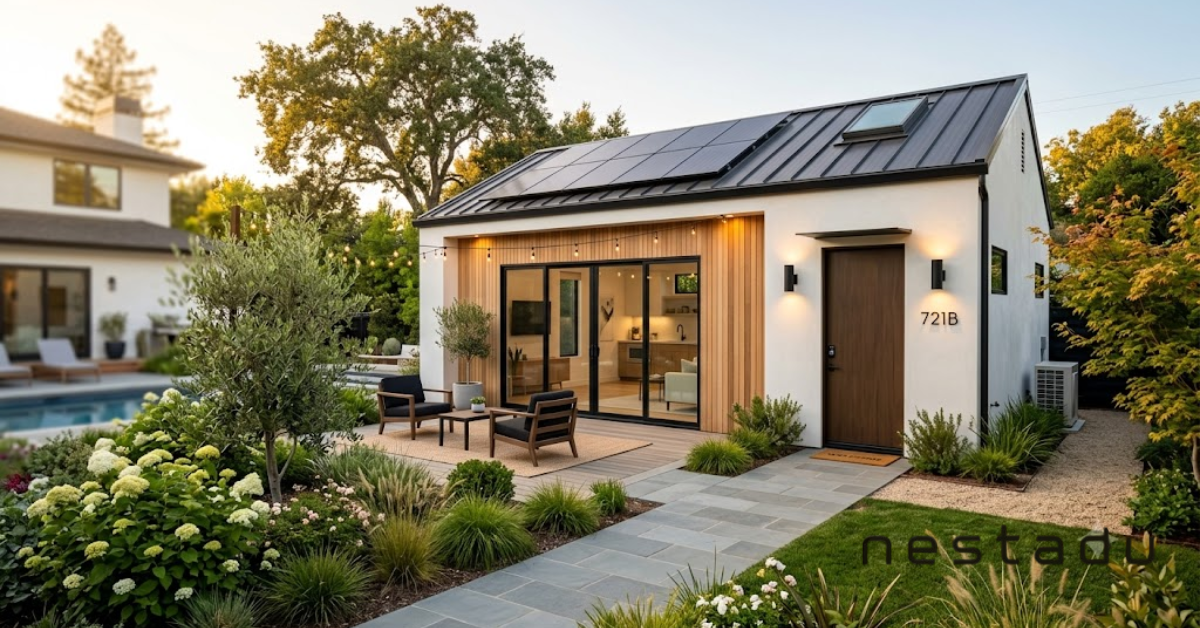
Homeowners benefit from building an ADU in four main ways: steady rental income, a measurable increase in property value, private housing for aging parents or adult children, and flexible square footage that can change purpose over the years.
In California, where a second home purchase is out of reach for most families, the backyard has quietly become the most practical place to add space.
Homeowners Benefited From Building an ADU
The interest is not theoretical. California cities have been issuing ADU permits at record levels since the state loosened its rules, and the units getting built are not vanity projects. They are income properties, in-law suites, and home offices that pay for themselves.
Rental Income That Covers a Real Chunk of the Mortgage
The most common reason homeowners call Nestadu is cash flow. A detached one-bedroom ADU in most California metros rents in a range that meaningfully offsets a monthly mortgage payment, and unlike a stock portfolio, the tenant pays down your asset for you.
What the income picture usually looks like:
- Studio or junior ADU: smaller rent, lowest build cost, fastest payback period
- One-bedroom detached unit: the sweet spot for most owners, strongest rent-to-cost ratio
- Two-bedroom unit: highest rent, but higher build cost and longer permitting in some cities
- Mid-term rentals (travel nurses, relocating families): higher monthly rate than a standard lease, less turnover than nightly rentals
- Short-term rentals: highest ceiling, but city rules vary widely and some jurisdictions restrict them
Most homeowners we work with think in terms of payback period rather than yield. Once the unit is rented, the question stops being “can I afford this” and becomes “how fast does this pay for itself.”
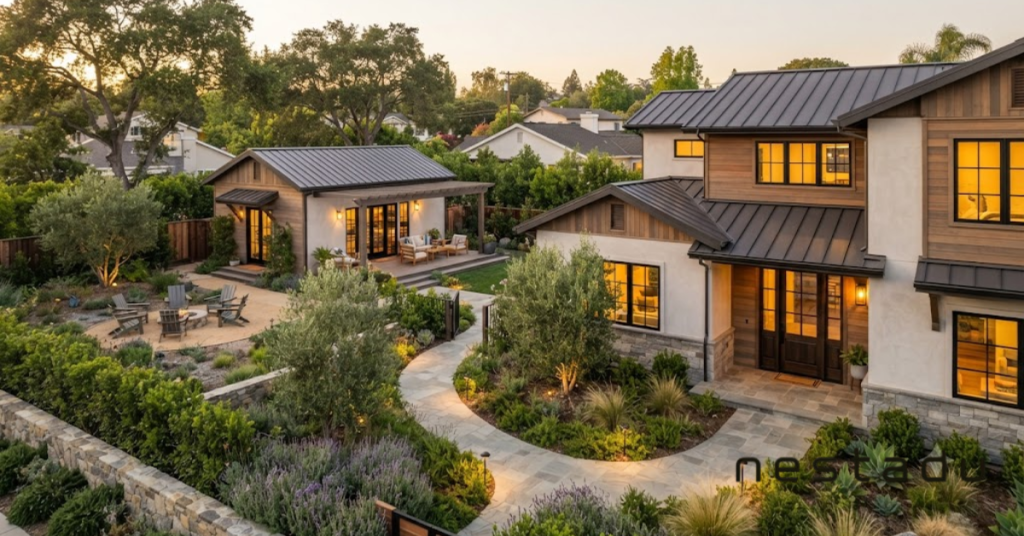
Property Value Goes Up, and Appraisers Now Have Comps
For years the appraisal problem was real. There were not enough sold ADU properties for an appraiser to compare against, so the value of the unit did not always show up on paper. That has changed as ADU inventory has grown across California.
A permitted, properly finished ADU adds value because it adds legally rentable square footage. Three things drive how much value it adds:
- Permit status. Unpermitted units are a liability at resale, not an asset. Buyers discount them and lenders may refuse them.
- Independence. A separate entrance, full kitchen, and its own bathroom is what turns a “bonus room” into a dwelling unit.
- Build quality. Sloppy finishes and mismatched rooflines drag the whole property down. This is the part Nestadu is unusually strict about.
The value increase generally scales with the income the unit can produce, which is why a well-built rentable unit outperforms a converted garage with a hot plate.
Housing Parents and Adult Kids Without Losing Privacy
Multigenerational living is the second big driver, and for many families it is the real one. Nobody wants to move a parent into a spare bedroom and lose their own living room in the process.
An ADU solves the proximity problem without the friction:
- Aging parents stay close, with their own door, kitchen, and daily routine
- Adult children get somewhere to live while saving for a down payment
- Caregiving becomes practical instead of a two-hour round trip
- The unit converts to a rental later, once the family situation changes
Compared to the ongoing monthly cost of assisted living, a one-time build cost that also adds property value is a different kind of math entirely. Families run those numbers once and usually stop debating.
One Building, Several Jobs Over Its Lifetime
The most underrated benefit is that an ADU does not have to commit to a single purpose. Homeowners rarely use the unit the same way in year eight that they did in year one.
A typical arc looks like this:
- Years 1 to 2: home office or studio, when you need quiet more than income
- Years 3 to 5: rental unit, once the office moves back inside
- Years 6 to 10: in-law suite, when a parent needs to move closer
- Later: guest house, or your own downsizing unit while you rent out the main home
That last option surprises people. Some California homeowners eventually move into the ADU and rent the primary house, which flips the income equation entirely in their favor.
Cheaper Than Moving, and You Keep Your Tax Basis
Trading up to a larger home in California means a new purchase price, a new mortgage rate, transfer costs, and a reassessed property tax bill. Building an ADU avoids most of that.
Under Proposition 13, the main house keeps its existing assessed value. The county reassesses only the new construction, so your tax increase is tied to the ADU itself rather than to the full current market value of your entire property. That distinction saves homeowners real money every year, indefinitely.
Add in the moving costs you never pay, the agent commissions you never pay, and the interest rate you never renegotiate, and staying put starts to look like the aggressive financial move rather than the cautious one.
California Law Is on the Homeowner’s Side Right Now
The regulatory environment is the reason ADUs went from niche to mainstream. State legislation over the past several years has stripped away most of the local obstacles that used to kill these projects.
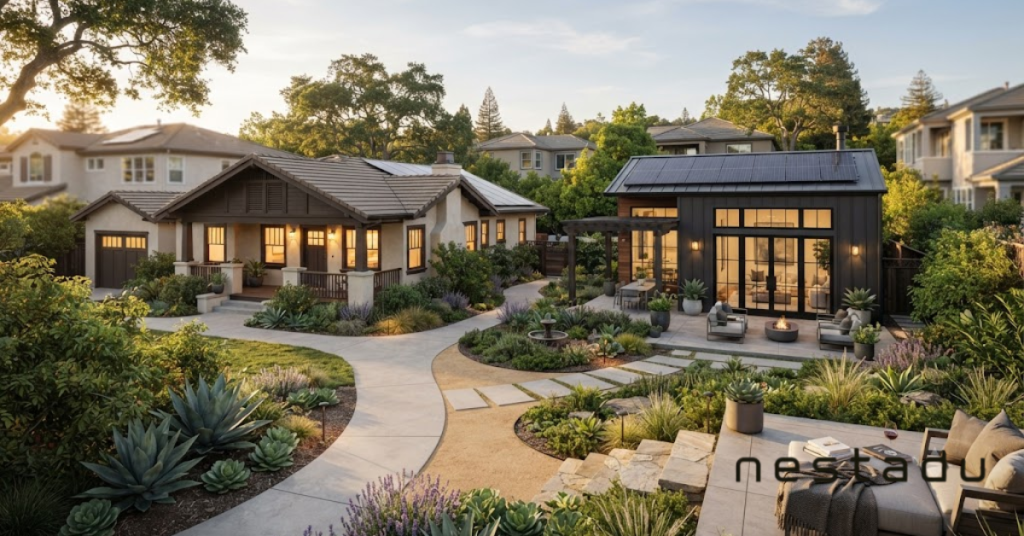
What the current rules generally mean for homeowners:
- Cities must approve compliant ADU applications through a ministerial process, without discretionary hearings
- Owner-occupancy requirements have been widely relaxed, so you can rent both units
- Parking requirements are waived near transit and in many other situations
- HOAs cannot flatly ban ADUs on single-family lots
- Approval timelines are capped, so applications cannot sit in limbo indefinitely
Local rules still vary on setbacks, height, and utility connections, which is exactly where a California-based builder earns their fee. Nestadu handles the city-by-city differences so homeowners are not learning zoning code on the weekend.
What Homeowners Say They Wish They Had Known
The regrets we hear are almost never about the decision to build. They are about execution details that were invisible at the start.
The ones that come up most:
- Utility connections, especially sewer and electrical panel upgrades, can be a bigger line item than expected
- Setbacks and lot coverage limits shape the floor plan more than personal preference does
- Cheap finishes cost more over five years than good finishes cost upfront
- The builder you pick determines whether the timeline is realistic or fictional
None of these are reasons to skip the project. They are reasons to plan it properly with someone who has already handled the same city, the same inspectors, and the same utility company.
Turning Your Backyard Into Something That Pays You Back
Homeowners have benefited from ADUs because the unit does several things at once. It produces income, it adds value that shows up at resale, it keeps family close, and it adapts as life changes. Very few home improvements can claim more than one of those.
Nestadu builds ADUs across California with transparent pricing, clean design that matches the existing home, and a process that runs from concept through final inspection. If you want to know what your lot can actually support and what it would cost, book a consultation and we will walk your property with you.
FAQs
How much rental income can a California ADU generate? It depends on size, location, and rental type. One-bedroom detached units command the strongest rent relative to build cost in most California markets, and mid-term rentals often beat standard leases on monthly rate.
Does building an ADU raise my property taxes? Only partially. Under Proposition 13, your main home keeps its existing assessed value. The county assesses the ADU as new construction and adds that to your bill.
How long does it take to build an ADU? Design and permitting usually take longer than construction. Timelines vary by city, which is why the permitting stage is where an experienced local builder saves you the most time.
Can I sell the ADU separately from my house? In most cases no, though certain state programs allow separate conveyance under specific conditions. Assume it stays part of your property unless a specific program applies.
Do I have to live on the property to rent out my ADU? Owner-occupancy requirements have been widely relaxed under current California law, allowing many homeowners to rent both the main house and the ADU. Local rules still vary.